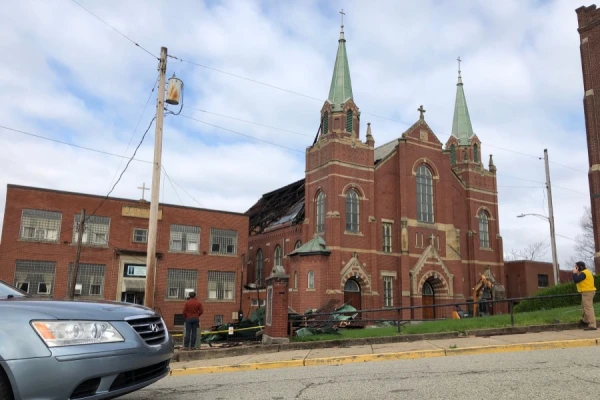
CNA Staff, Apr 8, 2020 / 02:00 pm (CNA).- A Catholic church in the Diocese of Greensburg was among the buildings heavily damaged by a tornado in western Pennsylvania early Wednesday morning.
Much of the roof of St. Mary of Czestochowa church was blown off during strong winds and heavy rains as a tornado touched down in New Kensington at 1:19 in the morning, according to the National Weather Service. About 15 minutes before the tornado, at 1:06 a.m., the Pittsburgh International Airport recorded winds at 75mph, which is the highest-ever recorded thunderstorm wind gust at that location.
Fr. Michael Begolly, the pastor of St. Mary’s and its partner parish St. Joseph, said he was “devastated” upon seeing the damaged roof on Wednesday morning.
Begolly told the Pittsburgh Post-Gazette that he thought the winds “really sounded like a train” and that he was praying for the safety of everyone in New Kensington.
“And then when I came down here seeing the devastation, it’s just heart-breaking,” he said.
New Kensington is located about 18 miles northeast of the city of Pittsburgh, in the Diocese of Greensburg.
An aerial photographs show that nearly half of the church’s roof had been destroyed by the winds. Only the framework of the roof survived.
<blockquote class="twitter-tweet"><p lang="en" dir="ltr"><a href="https://twitter.com/hashtag/BREAKING?src=hash&ref_src=twsrc%5Etfw">#BREAKING</a>: St Mary of Częstochowa Catholic Church in New Kensington heavily damaged by storms overnight. <a href="https://twitter.com/hashtag/NewsChopper2?src=hash&ref_src=twsrc%5Etfw">#NewsChopper2</a> over the scene showing major roof and steeple damage. Other nearby buildings also damaged from storm. <a href="https://twitter.com/KDKA?ref_src=twsrc%5Etfw">@KDKA</a> <a href="https://t.co/ZUn6UWnuoC">pic.twitter.com/ZUn6UWnuoC</a></p>— Ian Smith (@ismithKDKA) <a href="https://twitter.com/ismithKDKA/status/1247861380537110528?ref_src=twsrc%5Etfw">April 8, 2020</a></blockquote> <script async src="https://platform.twitter.com/widgets.js" charset="utf-8"></script>
“Please pray for parishioners of this New Kensington parish, who suffered devastating news during Holy Week,” tweeted Catholic Accent, a publication of the Diocese of Greensburg, on Wednesday afternoon. “A severe storm early Wednesday morning caused major damage to the roof at St. Mary of Czestochowa Church in New Kensington.”
The full extent of the damage is currently unclear.
St. Mary of Czestochowa was founded in 1892 by a group of Polish immigrants who sought to attend Mass in Polish. With the assistance of a Polish priest in Pittsburgh, who advocated for them to the bishop of Pittsburgh, they founded the Society of Our Lady of Czestochowa that same year.
Construction on the first church building began in 1893, and the parish received their first pastor in residence that year. The existing building was completed in 1912, and underwent several renovations in the 1970s and 1990s, including the expansion of the parish’s organ. St. Mary of Czestochowa was partnered with St. Joseph Parish in 2008 as part of a restructuring of the Diocese of Greensburg.
In addition to the damage at St. Mary’s, the storm also damaged an airplane hangar and uprooted numerous trees.
If you value the news and views Catholic World Report provides, please consider donating to support our efforts. Your contribution will help us continue to make CWR available to all readers worldwide for free, without a subscription. Thank you for your generosity!
Click here for more information on donating to CWR. Click here to sign up for our newsletter.
Legatus President Stephen Henley is pictured here speaking at the organization’s 2025 annual conference last month in Naples, Florida. / Credit: Courtesy of Legatus
Miami, Fla., Mar 13, 2025 / 07:20 am (CNA).
In today’s culture, often hostile to expressions of faith, many Catholics struggle with how to hold true to their values within the workplace. That’s why, in 1987, Domino’s Pizza founder Tom Monaghan started the Catholic organization Legatus.
From the Latin word for “ambassador,” Legatus aims to empower Catholic presidents, CEOs, and managing partners to become what St. Paul coined “ambassadors for Christ,” explained Stephen Henley, president of Legatus.
Offering peer support groups, networking, speakers, pilgrimages, and an annual international summit, Legatus’s goal is to “inspire members to live out their faith in all aspects of their life.” There are currently about 90 Legatus chapters in North America.
Chapter meetings are held once a month, providing the opportunity for members and their spouses to participate in confession and Mass, the recitation of the rosary, a cocktail reception dinner, and a speaker’s presentation.
“All of this is to help fortify the members’ marriage, the peer support group, the networking of this group, and then embolden them to go out and live their faith,” said Henley. “Tom felt that if we can bring together these Catholic CEOs, how much more can we change society with these people that have high impact and high influence?”
In interviews with Catholic News Agency, Hawkins, Dean Abela, and Henley covered three tips for bringing the Catholic worldview into the workplace.
Commit to your priorities
Dean Andrew Abela’s Catholic faith wasn’t always as important to him as it is now. As a teenager, he even stopped practicing.
“I came back in my mid-20s, funnily enough, while I was in business school,” he recalled. As a student in 1991, he encountered Pope John Paul II’s new encyclical letter Centesimus Annus, and the pope’s reflection on economics changed the trajectory of his life.
“Just a few months after, I returned to the Church,” he said. “When I reverted to the faith, I wanted to know what my newly rediscovered Catholic faith meant for a life in business.”
Andrew Abela is dean of the Busch School of Business at The Catholic University of America. Credit: Legatus
After working for companies including Procter & Gamble, McKinsey & Company, and the Corporate Executive Board, in 2002 Dean Abela eventually began teaching at the Catholic University of America. He is also a consultant to Fortune 100 corporations.
“The reason I left business and switched to academia was that I wanted to dedicate myself full-time to studying questions about what it means to be a faithful Catholic in the workplace,” he explained.
A member of Legatus since 2000, Dean Abela mentioned that members can follow what the organization terms a “spiritual plan” to attend daily Mass, recite the rosary daily, and do monthly confession.
Known as Tres Magna, or the “Big Three,” this plan was inspired by Miami Dolphins head coach Don Shula, who “attributed the perfect season to him going to daily Mass,” explained Stephen Henley. “Tom [Monaghan] thought, well, if he can go, there’s no reason why I can’t go.”
“Daily Mass, daily rosary, and monthly confession will align your life and priorities,” added Henley.
Find a supportive community
When Kristan Hawkins first encountered Legatus, she was not a Catholic. Hawkins was raised an Evangelical. After Students for Life’s 2006 launch, she began speaking at Legatus events.
In 2014, Hawkins decided to visit the Basilica of Our Lady of Guadalupe in Mexico City, “a pilgrimage Legatus had sponsored.” “I was the only Protestant there,” she recalled. “I decided there that I was going to enter RCIA.”
She became a full-fledged member of Legatus soon after becoming Catholic.
“As a pro-life activist who starts a pro-life organization, I want to save babies, I want to end abortion, I want to help as many families and women. You don’t start a non-profit because you’re necessarily a great business leader or have all these skills. You started this non-profit, this mission, because you want to see this mission accomplished,” Hawkins said. “For me, that’s one of the powerful benefits of being in Legatus, is having friends and mentors who were successful in the for-profit world who I can call on and ask questions.”
Students for Life of America President Kristan Hawkins. Credit: Legatus
“It’s very powerful and important to have those relationships. For me, in the work I’m doing, it’s a constant spiritual attack,” she added. “One of the best things about Legatus is I can call any of my Legatus friends at any moment, and they’ll be there for you. They know the power of the work we do and the resistance we face.”
Dean Abela also finds a sense of community in Legatus and also strives to build a supportive Catholic community at the Catholic University of America.
“We share with students the principles of Catholic social doctrine, things like human dignity and solidarity, and try to embed these principles into all of our classes,” he explained. “We’re also increasingly trying to give them opportunities to practice different virtues as part of their studies and schoolwork.”
For instance, Dean Abela explained, “To teach graduate students about decision-making, we go through a couple of survivor simulations, where you crash land in the north of Canada and you have to decide what you’re going to do. We have them go through decision-making exercises explicitly practicing the virtue of prudence or practical wisdom, the habit of making wise decisions. We break apart the components of practical wisdom, which include things like alertness, preparedness, and reasoning, and we have them try to exercise those as part of the decision-making process.”
These skills built in the classroom can be applied not only in business, but also in students’ personal lives.
Model the behavior you expect from others and celebrate your co-workers’ integrity
For Henley, giving authentic witness to the Catholic faith in the workplace can start with a simple “hello.”
“First, live the golden rule,” he said. “When you’re walking down the hall, say hello to the janitor, to the executive, and to everyone in between. It matters a lot.”
He added: “Another practical thing: take the opportunity to pray before meals. If you’re going on business lunches, you’ll be surprised at how many people say, ‘Yeah of course, let’s pray.’ It’s more common than not for people to pray before meals. The fact that you’re doing it shows that you’re a bold leader and that you’re spiritual.”
Dean Abela agrees that these types of habits make all the difference, and were the subject of the presentation he made of his book Superhabits: The Universal System for a Successful Life last month during the 2025 Legatus Summit.
“The main focus of the book is understanding that things like diligence, honesty, and resilience are not genetic characteristics. They are habits that anyone can acquire through practice,” Dean Abela explained. “Companies can focus on one of the most important virtues and give employees opportunities to practice those virtues.”
For instance, Dean Abela explained the GrowVirtue App, an AI-driven app “based on the work of the book,” which organizations can use to evaluate which virtues their company has already made a habit of, which virtues they might target, and tips for how to make progress.
“The important thing is that the company would choose a virtue that they think would be directly beneficial to the company right now,” said Dean Abela. “Although personal results are private, the whole company can see what employees as a whole are weakest in. So, if you’re trying to grow in customer service, you might encourage the virtue of friendship or friendliness.”
Dean Abela discussed the value of recognizing virtue both inside and outside the company.
“See examples in action or read about examples,” he suggested. “You can have employees watch videos or you can share articles that demonstrate examples of a particular virtue in action. And you can make sure senior folks are role models for junior employees.”
“Most importantly, give the employees the opportunity to practice the virtues, and give feedback,” he added. “When companies give awards, they tend to do this more with core values. They should shift to core virtues and give it to people who are exemplars of that virtue.”
Ultimately, the goal for Catholics is to live authentic lives that draw others to Christ.
“Stay true to who you are, don’t give in,” said Hawkins. “They’ll know you by your fruits. I think that’s very important. You don’t have to work in the pro-life movement or specifically in an apostolate to be a good Catholic, a faithful Christian in the workplace. You can do that in any job, in any position you have – in McDonald’s or in a Fortune 500 company.”
Washington D.C., Dec 5, 2019 / 01:00 pm (CNA).- Speaker of the House Nancy Pelosi on Thursday rejected the suggestion that she “hates” President Donald Trump, and said that her Catholic faith prevents her from hating anyone.
“I don’t hate anybody. I was raised in a Catholic house, we don’t hate anybody—not anybody in the world,” said Pelosi. She had been asked by a journalist during her weekly press briefing if she “hates President Trump.”
Pelosi had earlier announced the House Democrats would begin drafting the articles of impeachment.
“As a Catholic I resent you using the word ‘hate’ in a sentence that addresses me,” a visibly angered Pelosi said, pointed her finger at the journalist. She went on to claim that she prays for Trump “all the time.”
“So don’t mess with me when it comes to words like that,” she added. The Speaker said that any disagreement with Trump was rooted in policy, not in who he was as a person.
Pelosi has in the past encouraged people to pray for President Trump. In October, Pelosi said that people should pray for the president’s health after she abruptly left a meeting with the President. In September, Pelosi said that she prays for the Trump family “all the time,” and that she “wish(es) that he would pray for the safety of other families and do something courageous on guns.”
On Twitter, Trump said that he did not believe Pelosi prays for him, “not even close,” and that Pelosi had suffered a “nervous fit” during her briefing.
“She hates that we will soon have 182 great new judges and sooo much more,” said Trump. “Help the homeless in your district Nancy,” he added.
Pelosi has repeatedly cited her Catholic faith in the political realm, and used it to justify her positions, especially her long-standing support for abortion. Pelosi’s statements have occasioned significant pushback from members of the Catholic hierarchy at different times.
In 2008, in her second year as Speaker of the House, Pelosi stated on an August 24 episode of “Meet the Press” that “as an ardent, practicing Catholic, [abortion] is an issue that I have studied for a long time. And what I know is, over the centuries, the doctors of the church have not been able to make that definition,” and that her faith “shouldn’t have an impact on a woman’s right to choose.”
At least 22 bishops released statements correcting Pelosi on this statement, and clarified the Church’s teachings on abortion.
“While in canon law these theories led to a distinction in penalties between very early and later abortions, the Church’s moral teaching never justified or permitted abortion at any stage of development,” said a statement published Aug. 25, 2008 by Cardinal Justin Rigali and then- Bishop William Lori.
At the time, Rigali was the chair of the USCCB’s pro-life activities committee, and Lori led the USCCB Committee on Doctrine. Lori is now the Archbishop of Baltimore and Rigali retired in 2011.
In June 2013, Pelosi opposed a bill that would ban abortion after 20 weeks gestation and said that the bill was an effort to ensure that “there will be no abortion in our country.”
“As a practicing and respectful Catholic, this is sacred ground to me when we talk about this,” she said at the time. “I don’t think it should have anything to do with politics.”
Police gather at Annunciation Catholic School in Minneapolis on Aug. 27, 2025, following a mass shooting that killed two children and injured 17 others, 14 of them children. / Credit: Chad Davis, CC BY 4.0, via Wikimedia Commons






Leave a Reply