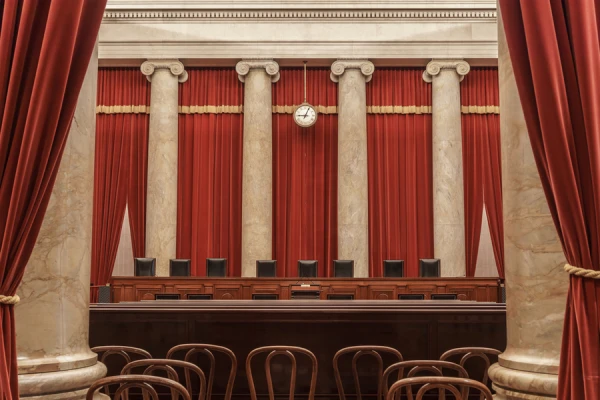
Washington D.C., Jan 23, 2020 / 08:30 am (CNA).- The Supreme Court considered arguments on Wednesday on whether a state bar on public funding for religious groups is discriminatory, or protects them from state interference. At issue during the arguments was the anti-Catholic bigotry which informed the Montana law’s passage
Oral arguments were heard Jan. 22 on the case of Espinoza v. Montana Department of Revenue, which involves the 1972 Montana state constitution’s prohibition on public funding of religious institutions.
At issue is a clause in Montana’s 1972 state constitution that goes back to its original constitution of 1889—forbidding public funding “for any sectarian purpose or to aid any church, school, academy, seminary, college, university, or other literary or scientific institution, controlled in whole or in part by any church, sect, or denomination.”
In 2015, the Montana state legislature approved a scholarship program for low-income students where tax credits could be claimed for donations to a scholarship fund. The fund would help students attend private schools, including religious schools.
The state’s revenue department blocked the program, saying the state’s constitution barred public funding of schools of a “church, sect, or denomination” and ruling that the scholarships could only be used for secular schools.
In response, several parents sued the state to use the scholarships for religious schools and a Montana trial court ruled in their favor. The state supreme court reversed that decision in 2018, and struck down the program altogether. The case will be decided by the Supreme Court this term.
Opponents of the law say it violates the “Free Exercise” clause of the U.S. Constitution, unlawfully shutting religious groups out of neutral public benefits. They also say the original 1889 clause was passed during a time of anti-Catholic bigotry, to bar Catholic schools from funding that the largely Protestant public school system benefitted from.
During oral arguments on Wednesday, multiple exchanges focused on the Montana law’s roots in the anti-religious bigotry of the 1800s, and whether its inclusion in Montana’s 1972 constitution was a continuation of that bigotry.
“I mean, I think that in the 1880s, there was undoubtedly grotesque religious bigotry against — against Catholics,” said Adam Unikowsky, arguing on behalf of the Montana Department of Revenue.
“That was the clear motivation for this,” Justice Brett Kavanaugh replied.
“In the 1972 Constitution, which is where this provision was enacted, I don’t think there’s any evidence whatsoever of any anti-religious bigotry,” Unikowsky said.
Justice Sonia Sotomayor had earlier noted a “long history” of people opposing public funding of religious groups. She implied that Montana in 1972 no longer exercised the anti-Catholic bigotry of the 1800s but still chose to bar public funding of religion in line with the U.S. Constitution’s “Establishment Clause.”
Justice Samuel Alito asked how it wasn’t merely coincidental that laws such as Montana’s occurred in a time of anti-Catholic bigotry.
“I’m not going to get into an argument with you about what happened in 1972, but do you really want to argue that the reason why a lot of this popped up beginning, coincidentally, in the 1840s, at the time of the Irish potato famine, that had nothing to do with discrimination based on religion?” Alito asked.
The brief of the parents before the Supreme Court argued that three separate clauses of the U.S. Constitution—“[t]he Free Exercise, Establishment, and Equal Protection Clauses—all provide that government should be neutral, not hostile, toward religion.
“Prohibiting all religious options in otherwise generally available student-aid programs rejects that neutrality and shows inherent hostility toward religion,” the brief states.
On Wednesday, two leading U.S. bishops said the Espinoza case could decide the legitimacy of anti-religious discrimination in the U.S., and continue historic anti-Catholic bigotry.
Amendments such as Montana’s “were the product of nativism,” read a joint statement of Bishop George Murry of Youngstown, Ohio, the chair of the U.S. bishops’ religious freedom committee, and Bishop Michael Barber, S.J. of Oakland, California, the chair of the U.S. bishops’ education committee.
“They were never meant to ensure government neutrality towards religion, but were expressions of hostility toward the Catholic Church. We hope that the Supreme Court will take this opportunity to bring an end to this shameful legacy,” the bishops said.
After Wednesday’s oral arguments, Eric Baxter, senior counsel at Becket, tweeted that “the justices seemed to agree that excluding students just because they are religious is a clear violation of the Free Exercise Clause.”
Montana’s clause is one of 37 “Blaine Amendments” passed by states in the late 19th century. They are named for James Blaine, a former Speaker of the House (1869-1875), Senator (1876-1881) and Secretary of State (1889-1892) from Maine who pushed an amendment to the U.S. Constitution barring funding of “sectarian” causes and organizations.
At that time, opponents of the law say, Blaine’s effort mainly targeted Catholic schools and institutions. His amendment failed at the federal level but many states including Montana inserted similar language in their constitutions.
In a 2017 case, the Supreme Court in Trinity Lutheran Church of Columbia, Inc. v. Comer ruled that Missouri’s Blaine Amendment could not block a church-owned playground from applying for state renovation grants, simply on account of its religious status.
However, a concurring opinion from Justices Clarence Thomas and Neil Gorsuch warned that the Court’s language implied a very narrow ruling on “playground resurfacing” cases, and not on general cases of religious groups accessing public funds.
On Wednesday, Justice Elena Kagan distinguished between the Court’s Trinity Lutheran case—regarding access to a “completely secular public benefit” like playground resurfacing grants—and Montana’s case where the scholarship program could be considered by the state to “subsidize religious activity.”
Justice Stephen Breyer asked if government could provide police protection for all schools but not religious schools, to which Unikowsky answered that it would be unconstitutional to do so, under the Trinity Lutheran decision. However, he said, there was a difference between government “distinguishing among religions”—such as allowing access to benefits for Catholic schools but not Jewish schools—and simply removing itself “out of religion altogether.”
In 1972, religious leaders were some of the supporters of the “no-aid” clause, Unikowsky said, because they warned about “using government leverage to influence religious education.”
Kavanaugh replied that “a religious school that doesn’t want to be part of a neutral program doesn’t have to be.”
 […]
[…]