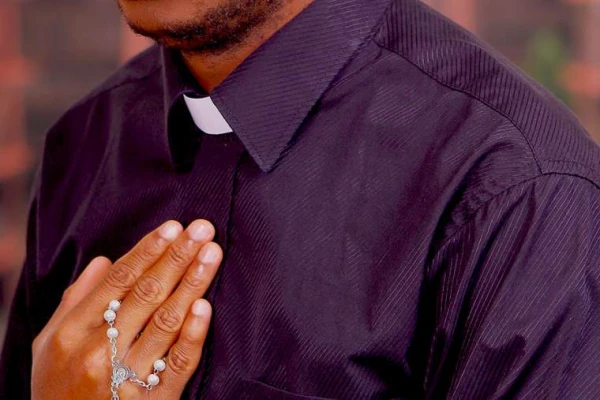
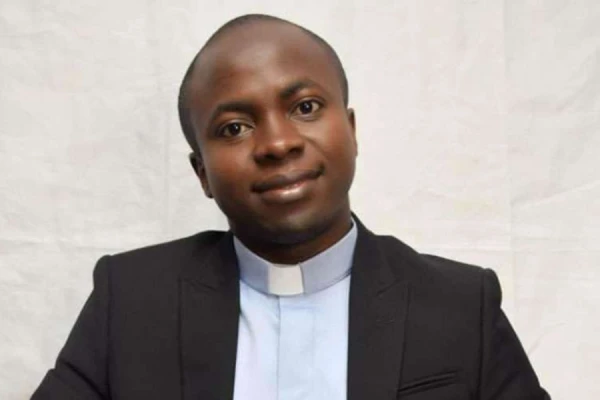
Enugu, Nigeria, Aug 2, 2019 / 06:01 pm (CNA).- Priests of southeastern Nigeria’s Diocese of Enugu protested Friday government inaction in the face of widespread violence. Fr. Paul Offu, a priest of the diocese, had been murdered the previous day.
Offu was shot to death Aug. 1 in the Awgu local government area, about 20 miles south of Enugu.
He was from Enugu state, and had been the pastor of St. James the Greater parish in Ugbawka.
The Enugu diocese wrote on Facebook that Offu was killed “by some hoodlums suspected to be the notorious and murderous Fulani herdsmen.”
Ebere Amaraizu, a public relations officers for Enugu police, said Aug. 2 that those responsible for the death were yet to be identified, according to the Daily Trust. The Nigerian outlet also indicated that Amaraizu indicated that the Fulani should not be blamed for the death before those responsible were apprehended.
Fr. Benjamin Achi, communications director for the Enugu diocese, told The Punch that “Fr. Offu was stopped by the murderous herdsmen while returning to his parish after a visit to priest friend.”
“They dragged him to the bush but one of the assailants said kill him that the church would not do anything if they kidnapped him,” Achi said, according to The Punch.
Priests of the Enugu diocese protested Offu’s death, marching Aug. 2 to the Enugu State Government House and police headquarters urging that officials do more to defend residents.
Violence against Christians has significantly increased in Nigeria in recent years, with the radical Islamist group Boko Haram threatening safety in the north, and smaller violent gangs threatening security in the south.
Fulani herders, most of whom are Muslim, have had increasing conflict with largely Christian farmers over limited natural resources in recent years.
If you value the news and views Catholic World Report provides, please consider donating to support our efforts. Your contribution will help us continue to make CWR available to all readers worldwide for free, without a subscription. Thank you for your generosity!
Click here for more information on donating to CWR. Click here to sign up for our newsletter.
CNA Staff, Mar 26, 2021 / 04:00 am (CNA).- A Catholic priest in Nigeria is recovering after a week-long kidnapping ordeal.
Fr. Harrison Egwuenu, a priest of the Diocese of Warri in Delta State, was freed on March 21, Fr. Benedict Okutegbe, administrator of Sacred Heart Cathedral in the city of Warri, confirmed on Thursday.
Okutegbe told ACI Africa, CNA’s African news partner: “We are grateful to God for the safe release of Fr. Harrison Egwuenu.”
He added: “Fr. Egwuenu is doing OK. Of course, he needs time to overcome the traumatic experience.”
The priest, who formerly served as Warri diocese’s director of social communications, thanked Catholics for their prayers for Egwuenu’s release.
“We all prayed and our prayers were heard. To God be the glory,” he commented.
Egwuenu was kidnapped March 15 as he was returning to St. George’s College, Obinomba, where he was recently appointed principal.
Okutegbe previously told ACI Africa that Egwuenu was seized by unknown gunmen at about 8 p.m. in Oria-Abraka, Ethiope East Local Government Area.
Nigeria has been experiencing insecurity since 2009 when a Boko Haram insurgency began with the aim of turning the country into an Islamic state.
Since then, the organization, which is one of the largest Islamist groups in Africa, has orchestrated terrorist attacks on various targets, including religious and political groups as well as civilians.
Insecurity has also increased in the West African nation due to the actions of predominantly Muslim Fulani herdsmen, who have clashed frequently with Christian farmers over grazing land.
Speaking to ACI Africa March 25, Okutegbe challenged the government, led by President Muhammadu Buhari, to put the safety of Nigeria’s 201 million citizens first.
“One of the primary duties of government is the protection of the lives and property of her citizens,” he said.
“There is need for the government to get to work and keep Nigeria safe and peaceful.”
“The government should wake up to this responsibility or give way to one who can.”
“How can there be sustainable development in a country whose security architecture has collapsed?”
“We demand more from our government. Not tomorrow but now.”
Nigeria’s Catholic bishops have repeatedly called on the government to put in place strict measures to protect its population.
“It is just unimaginable and inconceivable to celebrate Nigeria at 60 when our roads are not safe; our people are kidnapped, and they sell their properties to pay ransom to criminals,” members of the Catholic Bishops’ Conference of Nigeria said in an Oct. 1 statement, marking the country’s independence anniversary.
They added: “Nigerians are experiencing an invasion of their farmlands by armed Fulani herdsmen; a group well organized and already designated as the fourth deadliest terrorists’ group in the world by the Global Terrorism Index.”
A version of this story was first publishedby ACI Africa, CNA’s African news partner, written by Jude Atemanke. It has been adapted by CNA.
Christmas tree and Nativity scene in Faraya’s Public Square, a town in the Keserwan District of Mount Lebanon, in November 2024. / Credit: Municipality of Faraya
ACI MENA, Dec 2, 2024 / 08:00 am (CNA).
A gun was placed near a Nativity scene on Nov. 23 in the town of Faraya in the Keserwan District of Mount Lebanon in the country of Lebanon, sparking outrage among locals.
Residents gathered in the town square ringing the church bells in protest. Security forces have been assisting in efforts to calm the tensions.
The vandals acted at night, removing the statue of the Baby Jesus and leaving a handgun nearby.
Keserwan District is reputed to be the stronghold of Lebanon’s Maronite Catholics. It is home to significant landmarks such as the Shrine of Our Lady of Lebanon in Harissa and the Maronite Patriarchate in Bkerke.
Many see the act as an attempt to wreak havoc during the Advent season in a country currently hosting a large number of displaced people from war-torn regions. Others are awaiting the results of the investigation, according to ACI MENA, CNA’s Arabic-language news partner.
Christmas tree and Nativity scene in Faraya’s Public Square, a town in the Keserwan District of Mount Lebanon, in November 2024. Credit: The Municipality of Faraya
A parish priest’s appeal
Regardless of the motives behind the act, the incident provoked widespread anger.
Father Charbel Salameh, a parish priest, joined residents in the town square condemning the vandalism and reassuring locals at the same time.
In a brief video, he said: “We will remain vigilant in protecting our village. We hold on to preserving our unity and harmony, for the Lord brings us together. Perhaps this is an opportunity for all of us to gather here and pray in front of this Nativity scene for those trying to sow discord.”
He continued: “Let us not jump to conclusions: May God forgive those attempting to destabilize us. We are here to stay — this is our land, and this is our area. As children of the Church, we pray for whoever committed this act to understand that our sacred places cannot be easily violated.”
“What happened calls for great awareness because impulsiveness can harm us in circumstances as such. We pray that the Lord Jesus brings peace to the hearts and minds of the people and our country, Lebanon, in these difficult times,” he said.
Following the incident, Salameh replaced the missing statue of the Baby Jesus with another one from St. Charbel Church to temporarily fill the void. Security forces arrived on the scene, cordoned off the area, and launched investigations to analyze the circumstances and identify the perpetrators.
The statement of the municipality
The Municipality of Faraya clarified the circumstances of the incident in a statement:
“On Saturday, at 6 p.m., a citizen was taking photos of his grandchildren in front of the Nativity scene in the town square. Surprisingly, the children found a handgun lying on the ground. The man informed nearby shopkeepers. A municipal officer arrived at the square, inspected the site, and contacted security forces, who arrived promptly.”
The statement continued: “Upon investigation, the statue of Baby Jesus was found outside the Nativity scene, among nearby trees. Security forces confiscated the gun and began their investigation, concluding that the statue was not in the manger at the time children were taking photos. This proves that the incident occurred before the children and their grandfather arrived. The photos of the children in question confirm those allegations.”
“In light of these events, the Municipality of Faraya urges the residents and all inhabitants to remain united in brotherhood and love, as has always been the case. Faraya has long been a symbol of coexistence and a model for promoting peace, security, and hospitality,” the statement concludes.
A record of attacks
Last year, a series of attacks on Christmas symbols in Lebanon occurred, particularly in the northern region of Tripoli, home to an active Christian minority. These attacks ranged from dousing a tree with gasoline at St. George’s Church in Mina to throwing a Molotov cocktail at another tree in St. George’s Church square in Zaheriyah.
At the time, these unprecedented acts in the culturally and religiously diverse city were met with widespread condemnation from political, religious, and social leaders of various affiliations.
This story was first published by ACI MENA, CNA’s Arabic-language news partner, and has been translated and adapted by CNA.
A view of the modern area of the Catholic cemetery located on the southern hillside of Mount Zion in April 2024. In the background are the buildings of the Arabic neighborhood of Abu Tor. / Credit: Marinella Bandini





Leave a Reply