No Picture
News Briefs

Peace Cross case headed to Supreme Court

November 5, 2018 CNA Daily News 0

Washington D.C., Nov 5, 2018 / 12:00 pm (CNA).- The Supreme Court will once again consider the legality of religious monuments on public land during the current session.

The Court announced November 2 that it had granted certiorari to Maryland-Nationa… […]

Essay

Christ the Stronger Man

November 4, 2018 Fr. Charles Fox 5

“When a strong man fully armed guards his palace, his possessions are safe. But when one stronger than he attacks and overcomes him, he takes away the armor on which he relied and distributes the […]

No Picture
News Briefs

Pope Francis mourns victims of attack on Coptic Christians in Egypt

November 4, 2018 CNA Daily News 0

Vatican City, Nov 4, 2018 / 05:13 am (CNA/EWTN News).- Pope Francis expressed sorrow for the victims of an attack on Coptic Christians in Egypt in his Angelus address Sunday.

Islamic militants ambushed a bus carrying Coptic Christian pilgrims to a desert monastery south of Cairo on Friday, killing seven and leaving 19 injured.

“I pray for the victims, pilgrims killed just because they are Christians, and I ask Holy Mary to console their families and the whole community,” Pope Francis said Nov. 4.

The Coptic Orthodox Church held funerals on Saturday for six of the victims, who were killed while on pilgrimage to Saint Samuel the Confessor monastery in Egypt’s Minya province. The Islamic State claims to be behind Friday’s attack.

“Love for God and love for neighbor are inseparable,” Pope Francis said Sunday. “It would be an illusion to claim to love our neighbor without loving God; and it would be just as illusory to claim to love God without loving our neighbor.”

“My neighbor is the person I meet along my journey,” the pope said. I cannot “pre-select” my neighbor, he stressed, “This is not Christian.”

“Today’s Gospel invites all of us to be attentive not only towards the urgencies of the poorest brothers, but above all to be attentive to their need for fraternal closeness, for the meaning of life and tenderness,” Francis told the 20,000 people gathered in St. Peter’s Square.

“We can say that the hungry not only needs a plate of soup, but also a smile, to be heard, and even a prayer, maybe done together,” the pope continued.

Pope Francis expressed gratitude for the beatification of Blessed Mother Clelia Merloni on Saturday.

Mother Merloni was a 20th century Italian religious sister whose life was marked by both suffering and evangelical initiative.

As foundress of the Apostles of the Sacred Heart of Jesus, Merloni was “a woman fully abandoned to God’s will, zealous in charity, patient in adversity and heroic in forgiveness,” Pope Francis said.

“Let us give thanks to God for the luminous Gospel witness of this new Blessed and let us follow her example of goodness and mercy.”

[…]

No Picture
News Briefs

USCCB General Assembly: Committee elections preview

November 3, 2018 CNA Daily News 0

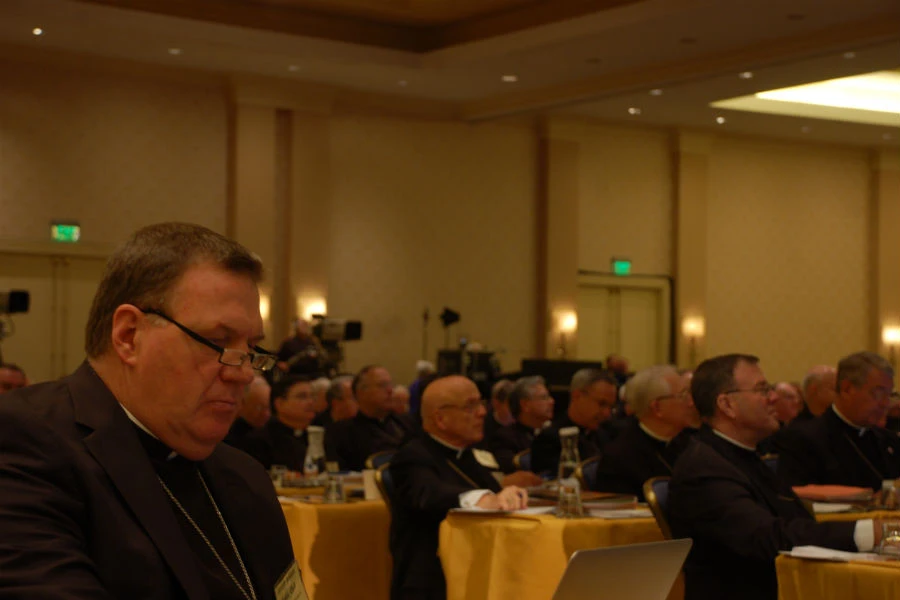
Washington D.C., Nov 3, 2018 / 02:00 pm (CNA).- When the United States Conference of Catholic Bishop convenes next week, much of the attention with focus on how the bishops will address the recent clerical abuse scandals. But the bishops will also be electing new leadership for six of the conference committees.


The USCCB will gather in Baltimore for its general assembly Nov. 12-14. On the ballot will be candidates for the chairman of the Committee on Catholic Education Committee, as well as the chairmen-elect of five other committees: Clergy, Consecrated Life, and Vocations; Divine Worship; Domestic Justice and Human Development; Laity, Marriage, Family Life, and Youth; and Migration.


The chairman-elect serves for one year shadowing the current chairman before assuming the role for a three-year term of office.


Conference members will also vote for a treasurer-elect for the USCCB. The office of treasurer manages the conference’s funds and sits as vice-chairman on the Committee on Priorities and Plans.


The current treasurer is Archbishop Dennis Schnurr of Cincinnati. Candidates to succeed him are Bishop Gregory Parkes of St. Petersburg, Florida, who worked in the banking industry for several years before entering the seminary and being ordained, and Archbishop Charles Thompson of Indianapolis, who holds a bachelor’s degree in accounting.


The current chairman for the Committee on Catholic Education is Bishop John Quinn of Winona. The committee seeks to guide the educational mission of the Catholic Church and advocates for public policies aligned with Catholic values.


The bishops nominated to follow him are Bishop Michael Barber of Oakland, who has served as the Director of the School of Pastoral Leadership in the Archdiocese of San Francisco, and Bishop David Malloy of Rockford, who has degrees in biology, theology, and canon law.


The Committee on Clergy is currently headed by Cardinal Joseph Tobin of Newark and produces and coordinates documents and resources for vocational promotion and discernment. The potential chairmen-elect are Bishop James Checchio of Metuchen, and Bishop Michael Olson of Fort Worth.


Archbishop Wilton Gregory of Atlanta is entering his final year as the head of the Committee for Divine Worship, which is responsible for matters related to Latin rite liturgy in the U.S. The candidates for chairman-elect are Archbishop Leonard Blair of Hartford, who has served on several conference committees, including those on evangelization and doctrine, and Bishop David Ricken of Green Bay, who is a member of the Bishops’ Advisory Council for the Institute for Priestly Formation.


The Committee on Domestic Justice and Human Development, now led by Bishop Frank Dewane of Venice, advises the U.S. bishops on national issues relating to human dignity, development, and poverty.


Archbishop Paul Coakley of Oklahoma City and Archbishop John Wester of Santa Fe have been nominated to succeed him. Wester has previously served as a member on the bishops’ committee on migration.


Archbishop Charles Chaput is now in the final year of his term as chairman of the Committee on Laity, Marriage, Family Life, and Youth, he will be replaced by either Archbishop Salvatore Cordileone of San Francisco or Bishop John Doerfler of Marquette.


Cordileone has served on the Governing Board of the International Theological Institute, while Doerfler has previously led the Marriage Research Committee of the Canon Law Society of America.


The Committee on Migration is currently chaired by Bishop Joe Vásquez of Austin. The committee seeks to provide awareness of and responses to the plight of immigrants, human trafficking, and refugees.


Washington, D.C. auxiliary Bishop Mario Dorsonville-Rodriguez of Washington, who has served as the director of the Spanish Catholic Center in Washington, and Bishop John Stowe of Lexington are the candidates to succeed him.

[…]

No Picture
News Briefs

Astronomers recommend renaming Hubble’s law to honor Belgian priest

November 3, 2018 CNA Daily News 2

Paris, France, Nov 3, 2018 / 12:01 pm (CNA/EWTN News).- The International Astronomical Union has voted in favor of a recommendation to rename the Hubble law the Hubble-Lemaître law, to acknowledge the contributions of the Belgian priest and astronomer Georges Lemaître to the scientific theory of the expansion of the universe.

“To honour the intellectual integrity and the supremely significant discovery by Georges Lemaître, the IAU is pleased to recommend that the expansion of the Universe be referred to as the Hubble–Lemaître law,” the association stated Oct. 29.

Fr. Georges Lemaître, who died in 1966, was a physicist and mathematician who is widely credited with developing the big bang theory to explain the physical origin of the universe.

Hubble’s law describes how objects in the expanding universe move away from each other with a velocity proportional to their distance apart.

A resolution to suggest the renaming of the law was presented and discussed at the IAU’s 30th General Assembly, held in Vienna in August.

“This resolution was proposed in order to pay tribute to both Lemaître and Hubble for their fundamental contributions to the development of modern cosmology,” the IAU noted.

Among the resolution’s desires was “to honour the intellectual integrity of Georges Lemaître that made him value more the progress of science rather than his own visibility.”

The IAU is an international organization of professional astronomers, and is the internationally recognized authority for naming celestial bodies.

More than 11,000 members were able to vote on the resolution. 4,060 members voted, with 78 percent approving the resolution, 20 percent rejecting, and two percent abstaining.

All the members, which include more than 10,000 individuals, were invited to vote electronically by Oct. 26. The IAU reported that 4060 members cast their vote, with 78 percent in favor and 20 percent against the name change.

Lemaître published a paper in 1927 discussing the rate of the expansion of the universe, but “the limited popularity of the Journal in which Lemaître’s paper appeared and the language used made his remarkable discovery largely unperceived by the astronomical community,” according to the resolution.

The resolution also noted that Lemaître, an IAU member since 1925, exchanged views about redshift with Hubble at the 3rd IAU General Assembly at Leiden in 1928.

Among other honors, the priest received the Francqui Price in 1934 from King Leopold III of Belgium, according to the Francqui Foundation. Father Lemaître had also been a past president of the Pontifical Academy of the Sciences.

[…]

No Picture
News Briefs

African fertility rates are falling – but not fast enough for some Western groups

November 3, 2018 CNA Daily News 1

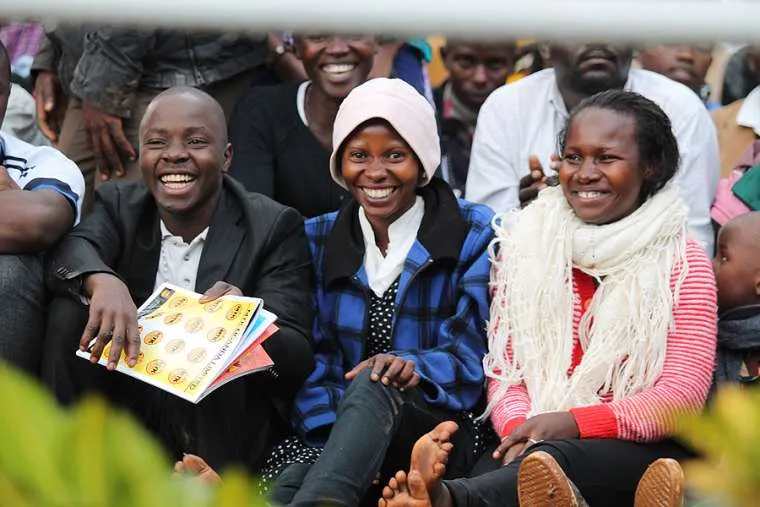
Washington D.C., Nov 3, 2018 / 07:01 am (CNA).- Despite recent disparaging Western commentary on high African birth rates, fertility rates on the continent are normal when viewed in the context of development, new data analysis from the Institute for Family Studies shows.

The analysis comes weeks after French President Emmanuel Macron commented at a Gates Foundation event in New York that educated women do not choose to have large families. “I always say: ‘Present me the woman who decided, being perfectly educated, to have seven, eight or nine children,’” he said.

While Macron clarified that he was speaking about the lack of educational opportunities in African countries, his comments struck a nerve with women in the United States and throughout the world. One professor at Catholic University of America started the hashtag  #PostcardsforMacron on social media, with which educated women from different countries shared photos of their large families.

In a new analysis published this week, Lyman Stone, a research fellow at the Institute for Family Studies, said that the fertility rate of most African countries is normal when other factors such as levels of development and child mortality rates are considered.

“What’s really going on here is quite simple: United Nations demographers have repeatedly messed up their forecasts of African fertility in more-or-less the same direction, and, rather than give a good explanation about why that is, the development community is responding by faulting Africans for having kids,” Stone wrote.

Each time the U.N. has forecasted Africa’s population for 2050, the numbers of their prediction have increased, causing some demographers to publish papers “bemoaning Africa’s curiously slow ‘demographic transition’ to near-replacement fertility,” Stone said.

For example, in 2008, the U.N. predicted that by 2050, the fertility rate in Africa would fall to about 2.5 children per woman, close to near-replacement rates, which range from about 2.1 to 2.3 children per woman.

But in 2017, the U.N. predicted that instead, the fertility rate in Africa by 2050 would be about 3.25 children per woman.

“This upward trend in forecast population stems from the fact that U.N. demographers have repeatedly overestimated how quickly Africa’s fertility would decline.”

But that doesn’t mean that Africa’s fertility rates are not declining overall, Stone noted. “You might think, then, that Africa’s fertility is rising! But actually, it isn’t! African fertility is falling!” he wrote.

Between 1965 and 2015, the fertility rate in Sub-Saharan African countries fell from almost 7 children per woman to slightly less than 5 children per woman. The decline has been slight, and slow, but steady – just not as dramatic as some Western groups had hoped, Stone noted.

“The entire scary story about African fertility really boils down to fractional differences in the rate of future fertility decline. In other words, Macron’s comments about ‘6 or 7 or 8’ kids are totally irrelevant,” he wrote.

“Africa’s ‘problem,’ as far as U.N. demographers are concerned, isn’t women having seven kids today; it’s women having three kids, 40 years from now when they ‘should’ have had just two.”

The complaint that the African population and fertility rates are high is not new, Stone noted – “it’s part and parcel of old-school racist colonialism. Colonial regimes often tried various inhuman measures to reduce population growth. It’s no surprise the successors to colonial regimes, do-gooder ‘family planning’ NGOs, are pushing the same concerns.”

One factor being ignored in the “fear-mongering” of those who say African fertility rates are too high is child mortality rates, which are typically good predictors of fertility rates, Stone said.

Typically, the more developed a country, the lower the child mortality rates and fertility rates are, he said. This is because as countries develop and people live longer, healthier lives, parents can reasonably expect that their children will live well into adulthood, driving down the need for many children in hopes that some will live into adulthood.

Furthermore, as people become more educated, they learn to manage their own fertility better, and have jobs “where brains are often more useful than brawn,” reducing the economic need for having more children.

When rates of child mortality are considered, the fertility rates in most African countries are normal, Stone wrote.

“Adding in control variables for urbanization or dependence on agriculture or natural resources doesn’t change the story: African fertility looks fairly normal for its level of development,” he said, when compared with similar countries in Asia, which have slightly lower fertility rates, and countries in Latin America which have higher fertility rates.

Africa is also a large and varied continent, and fertility rates vary significantly between its countries, Stone noted.

Furthermore, comparing fertility rates among developing countries also must take into account what kinds of family planning policies are being implemented in those countries, Stone said.

While Western groups like the Gates Foundation say that they want family planning policies in African countries to respect women’s freedom, at the same time they want the fertility rates in Africa to decline as dramatically as in countries such as China or India, which have implemented inhumane practices such as the “One Child” policy or forced sterilizations.

“In other words, Western donors need to get their story straight: do they want Africa to experience East-Asian style fertility declines, or do they want African countries to pursue democratically-compatible, rights-respecting population policies? You can’t have it both ways,” Stone noted.

In fact, Stone added, it is unclear why Western groups think they should get a say in African fertility rates at all.

“Western countries should have learned their lesson: it’s time to stop acting like African policy can be made from London or Paris or Seattle. Truth be told, Western organizations have no right, and no moral credibility, to step in and tell African women what they should or shouldn’t do with their bodies. We would be much better off looking for ways to solve our own fertility problems.”


[…]