No Picture
News Briefs

Archbishop Chaput on his new book about life in a post-Christian world

February 21, 2017 CNA Daily News 0

Philadelphia, Pa., Feb 21, 2017 / 02:50 am (CNA/EWTN News).- Archbishop Charles Chaput of Philadelphia’s new book, released on Tuesday, takes a hard look at how Catholics in the United States can live their faith in a public square which has become post-Christian.

CNA recently spoke with Archbishop Chaput about Strangers in a Strange Land: Living the Catholic Faith in a Post-Christian World, published Feb. 21 by Henry Holt and Co.

During the conversation, the archbishop discussed the changes seen in American public life in recent years, the role technology has played in these changes, and the place of law in the country’s ethos.

He also touched on Christian hope, the central importance of fidelity to Christ, and the temptation of conformity to cultural norms.
 
Please read below the full text of CNA’s interview with Archbishop Chaput:

Why did you feel the need for a new book after “Render Unto Caesar”?

I think the nine years since the release of Render Unto Caesar have seen a generational change in America. Boomers are aging out of leadership. Younger people are moving in. Their civic formation and memory – their understanding of the nation, the role of religious faith in public life, the nature of the Church – are very different from my age cohort.

The 1960s generation, my age group, had the benefit of moral and intellectual capital built up over many decades. We borrowed on it, even while we attacked it. Now a lot of it is used up. That has political consequences for the country and pastoral consequences for anyone trying to preach and live the Gospel. For example, what does a word like “salvation” mean to people who’ve been told since birth that they’re basically pretty good already, and if they’re not, it’s the fault of somebody or some force outside themselves?  

As Christians, we’re offering a salvific message in a therapeutic culture. It’s a tough sale.

Doesn’t “Strangers in a Strange land” as a title suggest a rather pessimistic view of the place Christians have in society today?

Realistic, yes; pessimistic, no. Optimism and pessimism are equally dangerous because both God and the devil are full of surprises. About three-quarters of Americans still self-identify as Christians. Tens of millions of them actively and sincerely practice their faith. I know dozens of young clergy and lay leaders who are on fire with God, and they’ll make a real difference in the world with their witness. So biblical faith still has an important influence on our public life.

But we’d be foolish to ignore the overall trends in American religious affiliation, which are not good.

You make the case in your book that we’re living in a “post-Christian world.” How so?

By “world” I mean mainly the developed countries of the north. In the global south, Christianity is generally doing very well and growing rapidly. But the north has the wealth and power, and therefore the ability to shape much of the dialogue about international trade, politics, and even history. Take a creature like the European Union. The EU very deliberately ignores 1,500 years of Europe’s Christian heritage and defines itself in purely secular terms, as if a huge part of its own past never happened. In effect, it tries to create a new reality by erasing its own memory.

That’s a harder trick to pull off in the United States, because we have no negative experience of religious wars or state Churches, the nation’s religious roots are still fresh, and religious practice is still high. But if you unpack the subtext in some of today’s militancy about tolerance and diversity, you find the same disdain for Christian faith and morality.

What do you see as the main factors that have changed America’s religious landscape?

Some of the change is inevitable and good because we’re a country built on immigration, and our demography naturally changes over time. More important, I think, is that many of the developments in our legal and educational philosophies and our sexual mores over the past 60 years have not been friendly to religious belief, and especially to Christian faith. At the same time, technology has fundamentally altered the way we learn, live and work, how we imagine the “supernatural,” and even how we think, or whether we think at all, about God.

You mention the Obergefell v. Hodges Supreme Court decision as an emblem of the “many issues creating today’s sea change in American public life.” How so?

America is an invented nation. It has no history before the age of progress. It’s a country created and held together by law; and law not only regulates, it also teaches. Americans have an instinctive bias toward assuming that if it’s legal, it’s also morally acceptable. So what the law says about marriage, family and sex has a huge influence on how we actually live as a society. Obergefell was a watershed in how we view these things, and not for the better.

Can we find in our current circumstances some practical reasons for real hope, or are we Christians destined to live sort of “by hope alone”?

Jesus changed the world with 12 very flawed men. We have plenty of good men and women, and more than enough resources, to do the same. But not if we’re too self-absorbed and too eager to fit into the world around us to suffer for our faith. We’re not short of vocations. We’re short of clear thinking and zeal.

What makes Christian hope so radically different from the “hope and change” kind of political slogans common in the secular world?

Political slogans are designed to bypass the brain and go for the heart. They’re a shortcut that relieves people of the hard work of thinking. “Hope and change” is a classic example. The real issue in those words, which is never addressed, is why we should hope, and what kind of change do we want – because some change can be bad.

Christian hope is not an emotion. It’s based on our faith in a loving God, no matter how hard our circumstances. There’s a wonderful line in the King James Version of the Book of Job, where Job – who’s bitterly tested by God – says, “Though he slay me, yet will I trust in him” (13:15). That confidence, despite all the seeming evidence to the contrary, that’s the virtue of hope. And it’s very different from just choosing a positive outlook.

How does your vision of a great Christian past and a hopeful future differ from “Making America Great Again?”

The Christian past was great only to the degree that Christians were faithful to Jesus Christ and his Gospel. All the beauty of Christian art, music, architecture, culture and scholarship that we’ve inherited – all of it – depended on and derived from that fidelity. The same applies to how we build the future.

As for the country: We’ll make America great when we make America good. And that means laws and leaders and communities that embody justice, charity and a respect for the sanctity of human life from conception to natural death, and including the refugee and immigrant. Otherwise, “making America great again” is just the latest version of “hope and change.”

You say in your first chapter that there are things we Christians “should not bear, should not believe, should not endure in civic life.” Wouldn’t that make us “culture warriors” rather than evangelizers?

Preaching, teaching, defending and suffering for what we believe about God and his love for us are part of a culture war that goes back to Golgotha. These things are also called witness.

You quote Václav Havel saying that “the only way to fight a culture of lies…is to consciously live the truth.” What would it mean to live the truth for rank-and-file Catholics today?

Every Catholic every day has little opportunities to speak up to explain or defend his or her faith.  Nearly 200 years ago Alexis de Tocqueville – the great early chronicler of our nation’s life – noticed that Americans, despite all our talk about individual liberty, have a terror of being out of step with public opinion.

We don’t need more resources to renew the Church in the United States. We need more courage. And that begins with the honesty to live what we claim to believe as Catholics, whether public opinion approves or not.
[…]

No Picture
News Briefs

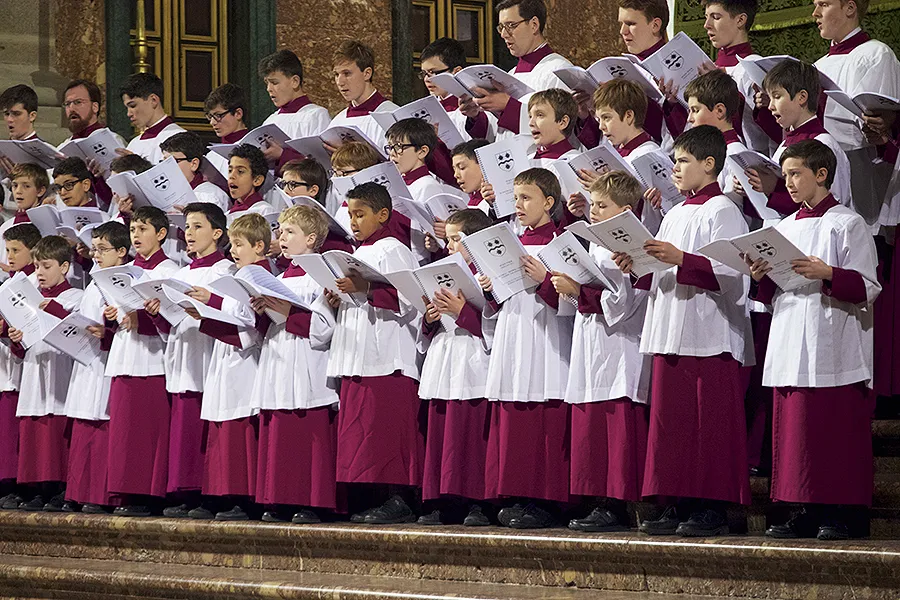
London choir aims to bring sacred music from the Masses…to the masses

February 21, 2017 CNA Daily News 0

London, England, Feb 21, 2017 / 12:02 am (CNA/EWTN News).- You may recognize the sound of the London Oratory Schola Cantorum Boys Choir from epic motion picture soundtracks like The Lord of the Rings, Harry Potter, or The Phantom of the Opera.


But the heart of the world-renowned Schola, which includes voices of boys ages 7-18, has always been liturgical music.


Now, the boys choir hopes to bring the sacred tradition of Renaissance liturgical music to a wider audience with their debut album, “Sacred Treasures of England”, produced in a partnership with AimHigher Recordings/Sony Classical, a sister label of De Monfort Music.


AimHigher Recordings CEO Kevin Fitzgibbons said he was impressed with the choir “from the first note.”


“Mirroring the majestic beauty of The Oratory itself, the repertoire from this debut recording is gorgeous and timeless,” he said.


The album features English Tudor-era motets by composers such as William Byrd and Thomas Tallis, as well as the magnificent Missa Euge bone by Christopher Tye, and is the first part of a series of albums of sacred music the choir will be producing.


Charles Cole, Director of The London Oratory Schola Cantorum Boys Choir, told CNA that the idea for the album series came from a desire to share the Schola’s large repertoire of liturgical music, comprised largely of music from Renaissance composers, with the world.


“The Schola’s primary role is the singing of this Liturgy at the Oratory and we will always be focused above all on that,” Cole said.


“However, the opportunity to work on new recordings gives us a wonderful opportunity to work with great intensity on particular areas of the repertoire and hopefully bring these wonderful works to be heard by a far larger audience.”


The album series is grouped by region or country, he said, allowing listeners “to delve into a particular sound world, and the English music on this first recording has some very beautiful characteristics.”


Fr. George Bowen, Chaplain of the London Oratory School and a priest of the London Oratory, said the album series offers the Schola a unique chance to evangelize.


“St. Philip Neri (founder of the Oratory brotherhood of priests) always wanted the Oratory to be outward looking; to evangelise. Sacred Music has always played a vital part in the work of evangelisation, and we hope that this CD will continue the tradition,” he told CNA.


The London Oratory Schola Cantorum Boys Choir, founded in 1996, is one of three choirs associated with the London Oratory. It provides school age boys with an education immersed in the experience of learning and performing sacred liturgical music.


The choir is in high demand, and sings frequently on tours throughout the world and for projects such as the CD, movie soundtracks or philanthropic concerts for organizations such as Aid to the Church in Need. They also sing for every Vigil Mass at the London Oratory during the school year.


It all takes an incredible amount of hard work and discipline, Cole said. The boys choir rehearse every morning before school for an hour, as well as several other times throughout their school day at the Oratory.


This discipline transfers into other areas of the boys’ lives – academics, athletics – but most importantly, their immersion in the liturgy “gives them a heaven-sent opportunity to develop a love of their Faith.”


“It is a very immersive experience for them, both musically and liturgically, allowing them to experience the beautiful repertory which adorns the major feasts of the Church year,” Cole said.


“We hope that this album will bring more and more people into contact with the beautiful musical treasures of the Church.”


The Schola will be going on tour to promote their new album, which will include a leg in the United States in October. For more information about the album, including the track list, visit: http://aimhigherrecordings.com/loscbc.php/. The album is available on Amazon and iTunes.

[…]

The Dispatch

Evangelizing through the good

February 21, 2017 Bishop Robert Barron 0

Anyone even vaguely acquainted with my work knows that I advocate vigorous argument on behalf of religious truth. I have long called for a revival in what is classically known as apologetics, the defense of […]

No Picture
News Briefs

How Catholic hospitals can help heal Syria – literally

February 20, 2017 CNA Daily News 0

Rome, Italy, Feb 20, 2017 / 02:08 pm (CNA/EWTN News).- There are about three million people without heath care in war-torn Syria, and the papal envoy to the country has launched a project to help some of them.

Cardinal Mario Zenari launched the Open Hospitals project to enhance and empower three Catholic hospitals in Syria. He visited Rome’s Gemelli Hospital to help promote the initiative.

“It is just a drop, albeit a very precious drop, in our sea of necessities,” the cardinal told CNA. “It is a sign of the solidarity of the Church toward so many poor people.”

“In the end, Catholic means ‘universal,’ that is, open to anyone who is in need. A Catholic hospital is, by its own nature, an open hospital,” he added.

Since March 2011, the Syrian Civil War has ravaged the country, killing hundreds of thousands and driving millions from their homes.

“A great number of health care facilities have been knocked out by warfare,” the cardinal said. “This is the moment to enhance and help three Catholic hospitals, managed by the religious congregation, that have been working in Syria for more than 100 years.”
 
Cardinal Zenari has been papal nuncio to Syria since 2008. Pope Francis made him a cardinal during the last consistory, an unusual honor for a residential nuncio that showed papal support for Syria.

The cardinal conceived the idea of the Open Hospitals effort with Msgr. Giampetro Dal Toso, secretary of the Dicastery for Promoting Integral Human Development, who visited Aleppo at the end of conflict in the city. The initiative is operated by the Catholic NGO AVSI, with the contribution of the Gemelli Foundation.
 
The project will collect and financially support three Catholic hospitals in Syria: the French Hospital in Damascus, owned by the Congregation of the Sisters of Charity of St. Vincent de Paul; the Italian Hospital ANSMI, managed by the Daughters of Mary Auxiliatrix; and St. Louis Hospital in Aleppo, managed by the Sisters of St. Joseph of the Apparition.
 
“These hospitals are held in great esteem for their professionalism, but they are also facing great economic difficulties because of the warfare,” Cardinal Zenari said. “As they are private institutes, they also need patients to pay for their care, even with a minimum amount of money. But these sick people cannot even give a minimum economic contribution, as 80 percent of the Syrian population is currently living in poverty.”
 
About 400,000 Syrians are estimated to have died in the war.
 
“However, the death toll for lack of health care and medicines is even larger,” the cardinal said. “Yes, it is necessary to repair and rebuild houses and infrastructure. But above all we should ‘repair’ the physical health of people.”
 
There are an estimated two million people without health care in Aleppo, and one million more in Damascus. Hence, the necessity to enhance and supply the three Catholic hospitals.

“Each of these hospitals is going to open new departments to face needs and urgencies that came out after the conflict: special departments for traumatized children, for women who were subjected to violence and rape during the conflict, and for those mutilated by war,” the cardinal said.

Reflecting further on the situation in Syria, he said that “suffering in Syria is universal, as every religious and ethnic group had its victims, its martyrs.” But, he added, “Christians are the minority group most at risk, as they have no weapons to defend themselves.”
 
The papal ambassador recounted that “Christian communities saw their villages and blocks invaded and there were churches damaged and destroyed.”
 
However, emigration represents the “biggest wound” to the community.

“For example, two-thirds of the Christian in Aleppo emigrated. This is an incalculable loss for the churches. Even if sacred buildings will be rebuilt, the question is whether Christian communities will be rebuilt the way they were before,” the cardinal said.
 
The churches are committed to charitable works for the whole community, an effort that is appreciated.

When Cardinal Zenari arrived in Syria eight years ago, he said, “there was a certain progress in the economic field, although not all society could benefit from that.”

“Yes, an improvement was needed in terms of respecting human rights and fundamental freedoms, but in general Syria was a mosaic of good coexistence among the ethnic-religious groups.”
 
Now, Syria is “profoundly lacerated by grave external wounds and grave internal wounds.”
 
Thinking about the future, the papal nuncio saw a need for a Syria that could enjoy the support of all social sectors and avoid the risk of dividing society between winners and losers.

For Cardinal Zenari, the Christian community could act as a bridge in a post-war Syria.

The new Syria should be “reconciled, more respectful of human rights and fundamental freedoms, more democratic,” with a “guaranteed territorial unity and integrity,” he said. He lamented that external forces like the Islamic State group have entered the Syrian conflict, among other regional and international powers.

Cardinal Zenari said that the most urgent challenge for Syria is to stop the violence and guarantee access to humanitarian aid.

Citing United Nations data, there are 13.5 million people in need of humanitarian aid, including 4.9 million who live in hard-to-access places. There are 640,000 people living in 13 places under military siege.

There are 6.1 million internally displaced Syrians and 4.8 million Syrians who have become refugees in other countries.

The cardinal stressed the need for determination to reach a political solution to the conflict. After the conflict, will require restoring the social fabric and working for reconciliation. He emphasized the need to rebuild houses, villages, and infrastructure.

[…]

No Picture
News Briefs

Overcome divisions to protect God’s creation, bishops ask US government

February 20, 2017 CNA Daily News 0

Washington D.C., Feb 20, 2017 / 02:03 pm (CNA/EWTN News).- The United States government has the opportunity to overcome political divisions and respond effectively to climate change, the nation’s bishops have said in a letter to the Secretary of State.

“The Judeo-Christian tradition has always understood the environment to be a gift from God,” the bishops said. “From time immemorial, the people of our nation have recognized this gift in our abundant and beautiful lands, pristine waters and clear skies. Rooted in this tradition, Pope Francis called on the world’s leaders to come together to protect the gift of our common home.”

The Feb. 17 letter to Secretary of State Rex Tillerson was signed by Bishop Oscar Cantu of Las Cruces,  chair of the U.S. bishops’ Committee on International Justice and Peace; Bishop Frank J. Dewane of Venice, chair of the U.S. bishops’ Committee on Justice and Human Development; and Sean L. Callahan, president of Catholic Relief Services.

“We have one common home, and we must protect it,” the letter said.

Its authors lamented that environmental issues can be “politicized for partisan agendas and used in public discourse to serve different economic, social, political and ideological interests.”

However, they said, Pope Francis’ encyclical Laudato si’ has invited everyone “to rise above these unhelpful divisions.” The Pope has rejected “a narrow understanding of climate change that excludes natural factors and other causes.”

The bishops said human-caused climate change is widely recognized, as is the importance to help communities and nations adapt in response.

“The poor and vulnerable disproportionately suffer from hurricanes, floods, droughts, famines and water scarcities,” they said.

Efforts to adapt to climate change must be accompanied by efforts to mitigate human contributions to climate change. The bishops stressed the importance of U.S. leadership and commitment to the international agreement on climate change signed in Paris in 2015. They called that agreement a “key step” to goals like curtailing carbon emissions and assisting vulnerable populations in the U.S.
 
The bishops asked Tillerson to support the Green Climate Fund that helps developing nations build resilience to climate change and recover from negative climate change impact.

They also called for an “energy revolution” that could provide sustainable, efficient and clean energy in a way that is “affordable, accessible and equitable.”

“This will require ingenuity, investment and enterprise, all virtues of the American people. Our leading scientists and engineers, research institutions and energy companies have already made great strides towards developing affordable clean energy,” the bishops’ letter said.

The U.S. has the opportunity to achieve energy security and assert global leadership in growing sustainable energy capabilities through infrastructure and technological investment, they continued.

“This is a time of both uncertainty and significant opportunity for our nation and world,” the bishops told Tillerson. “Filled with hope in God, we pray that your work may contribute to America’s material, social and spiritual wealth and further solidarity across the world.”

[…]