

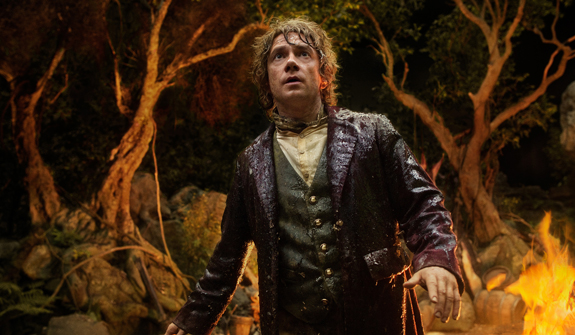

Director Peter Jackson does not disappoint. Like the great Lord of the Rings films, The Hobbit: An Unexpected Journey is filled with beautiful scenery, epic battle sequences, humor, good versus evil, and many lessons on true friendship and sacrifice. Avid Tolkien fans may notice some minor additional plot elements and bits and pieces of The Silmarillion, as well as parts from the appendices to the Lord of the Rings. However, these additions and minute changes do not diminish the greatness of Tolkien’s story. In an effort to extend The Hobbit into three epic films, these additions are necessary, and in my opinion, highly entertaining.
Contrary to what some popular reviewers have said, while The Hobbit may fall short of the book that inspired it—and what movie based on a book doesn’t?—I believe that Peter Jackson and his cohorts maintained the essence of Tolkien’s Middle-Earth and Bilbo’s fantastic journey. I may not like that they are making three films out of one book, but I remain pleased with the first installment. It was great to see some “old” friends from The Lord of the Rings and also to fall in love with the new characters.
Before Frodo’s quest to Mordor with the One Ring, depicted in The Lord of the Rings, the hobbit Bilbo Baggins is given “a little shove out the door” by the wizard Gandalf the Grey, embarking on a journey to reclaim the ancient dwarf Kingdom of Erebor. There, the evil dragon, Smaug, dwells beneath the Lonely Mountain, guarding the gold mined by the dwarves many years before. Bilbo, along with Gandalf, Thorin—the rightful dwarf king—and 12 other dwarves, must travel to the Lonely Mountain and defeat Smaug so that the dwarves may dwell again in what was once their greatest kingdom.
Bilbo lives a comfortable life, with no intention of stepping out further than the Shire. But Gandalf knows him better, and he makes Bilbo aware of how trapped he is in his comfort zone. Gandalf recalls when he knew Bilbo as a young hobbit with dreams of seeing the elves and mountains. “When did you start caring about doilies and your mother’s dishes?” Gandalf asks him. Gandalf insists that Bilbo has been “sitting still for far too long.” As Tolkien’s tale comes to life on the big screen, we see that real living is a journey that pulls us out of our comfortable selves and challenges us to pursue what is good and right and truthful.
After watching The Hobbit a second time (yes, a second time), I realized that this story calls its characters to poverty and humility—which in the end prove to be greater than power or glory. This seems most apparent not only in Bilbo’s character, but also in Thorin. The dwarves have already lost their home and their wealth, and Bilbo must learn to abandon his own home and everything and everyone he loves. His apparent lack of stature and power also prove to be more useful than Thorin or any of the dwarves originally thought. As Gandalf explains to Galadriel, it is not great power that will conquer evil, but the small and ordinary things. Gandalf chooses Bilbo, not because he is great, but precisely because of his insignificance. Hobbits are far removed from the rest of Middle-Earth, and as we well know from The Lord of the Rings, the humbleness of their race proves far more useful against the Enemy than any great army.
Gandalf serves as the company’s conscience through the majority of the film. He is far removed from material possessions and his heart does not lay claim on any home in Middle-Earth. Some Tolkienites might argue that he considers the Shire a home. But Gandalf’s preference for good weed aside, we know he is a guardian not from this world. He stands as the voice of reason, telling them to “Run!” or “Stand and fight!” when the dwarves cannot think for themselves. He is also the most aware of Thorin’s shortcomings, reminding him of his duties and keeping him humble when the others cannot. Gandalf uses his powers only when necessary—his main duty seems to be that of a guide. We know Gandalf’s abilities reach far beyond what he reveals here, but he chooses instead to play a minor role—only giving Bilbo, Thorin, and the dwarves the “shove” they need to act when they lack conviction.
This approach of Gandalf’s proves to be most effective for Thorin’s conversion to humility. From the beginning, we know Thorin to be a good dwarf—one who respects the loyalty and honor of his men—yet, he still lacks the humility and the willingness to sacrifice that is needed to restore his homeland. He knows from experience that the impossible can be achieved with very little—he allegedly destroyed a great orc with only an oak branch for a shield—and still, he doubts Gandalf and the wizard’s faith in Bilbo. If not for Gandalf’s prodding, Thorin’s pride would have prevented him from seeking the counsel of the elves, which would have left him unable to understand the map handed down to him by his forefathers. Good is not achieved until Thorin surrenders his pride. Only then may the dwarves take another step further on their quest.
However, Thorin still refuses to place his faith in a hobbit and in a wizard who continues to disappear without explanation. Thorin often speaks of Gandalf “abandoning” the company. Yet we always discover that Gandalf has only been “looking ahead” in an attempt to protect the company from further danger. Bilbo, too, disappears, and Thorin believes him to have given up. And again, we see Thorin proven wrong. Bilbo, although he may have considered leaving, does not abandon his friends—in fact, Bilbo saves the group from imminent danger and even death on numerous occasions. It is not until Bilbo saves Thorin’s life personally that Thorin’s heart and mind are finally changed.
Besides being a fantastic adventure, The Hobbit proves to be a lesson in faith. Not only faith in one’s friends, but faith in forces we do not understand. Not everything is as it seems, as Bilbo and Thorin in particular learn. Evil may seem powerful, grotesque, and, in Smaug’s case, fire-breathing, but as Tolkien so often suggests, size and power do not matter—in the end, simplicity and service to the good always reign supreme. As the title so clearly illustrates, The Hobbit is, in fact, an unexpected journey, and I look forward to The Desolation of Smaug.
If you value the news and views Catholic World Report provides, please consider donating to support our efforts. Your contribution will help us continue to make CWR available to all readers worldwide for free, without a subscription. Thank you for your generosity!
Click here for more information on donating to CWR. Click here to sign up for our newsletter.
