No Picture
News Briefs

Admit your wounds and receive mercy, Pope tells Chilean priests, religious
January 16, 2018 CNA Daily News 0

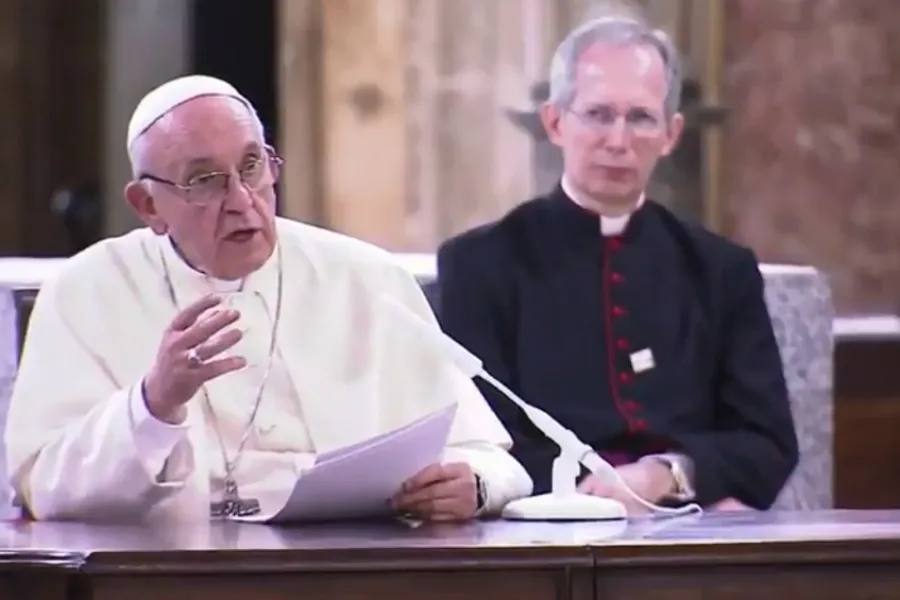
Santiago, Chile, Jan 16, 2018 / 02:13 pm (CNA/EWTN News).- Pope Francis said Tuesday that even amid the pain which results from sinfulness, the Church can still serve the world if she acknowledges the reality of her woundedness and puts Christ and his mercy at the center of all things.

“We are not asked to ignore or hide our wounds. A Church with wounds can understand the wounds of today’s world and make them her own, suffering with them, accompanying them and seeking to heal them,” the Pope said Jan. 16 at the Santiago Metropolitan Cathedral in Santiago, Chile.

“A wounded Church does not make herself the center of things, does not believe that she is perfect, but puts at the center the one who can heal those wounds, whose name is Jesus Christ.”

Pope Francis spoke during an encounter with priests, deacons, religious men and women, consecrated, and seminarians, where he was welcomed by Cardinal Ricardo Ezzati Andrello of Santiago.  The meeting took place as part of the Pope’s Jan. 15-22 apostolic visit to Chile and Peru.

Cardinal Ezzati reflected that “presbyteral and consecrated life in Chile have and do endure difficult times of turbulence,” and that while many have been faithful, “the weeds of evil have also grown, and their consequence of scandal and desertion.” He thanked Pope Francis for “your words which denounce sin and lukewarmness and, at the same time, your continuous calls to live the beauty of the election and the apostolic dedication of the consecrated vocation.”

Pope Francis said that it doesn’t help to try to hide wounds and sins: “whether we like it or not, we are called to face reality as it is – our own personal reality and the reality of our communities and societies.”

Even St. Peter had to acknowledge that he “was a sinner like everyone else, as needy as the others, as frail as anyone else,” Francis emphasized. “As disciples, as a Church, we can have the same experience: there are moments when we have to face not our success but our weakness.”

What made St. Peter an apostle? What makes us apostles? he asked. One thing alone: that we have received the mercy of Christ.

Francis outlined three moments in the Gospels where we can learn from St. Peter, even as imperfect and sinful people, to bring Christ to the world. These three moments the Pope called Peter disheartened, Peter shown mercy, and Peter transfigured.

Before the resurrection, but following Christ’s passion, St. Peter and the other apostles were “dismayed and confused,” Francis said. “These are the hours of dismay and confusion in the life of the disciple,” he said.

He pointed to the child sexual abuse scandal that has occurred within Chile as a “time of upheaval,” saying he is attentive to what priests, consecrated, and religious are doing “to respond to this great and painful evil.”

It is particularly painful, he said, “because of the harm and sufferings of the victims and their families, who saw the trust they had placed in the Church’s ministers betrayed. Painful too for the suffering of ecclesial communities, but also painful for you, brothers and sisters, who, after working so hard, have seen the harm that has led to suspicion and questioning; in some or many of you this has been a source of doubt, fear or a lack of confidence.”

“I know that at times you have been insulted in the metro or walking on the street, and that by going around in clerical attire in many places you pay a heavy price. For this reason, I suggest that we ask God to grant us the clear-sightedness to call reality by its name, the strength to seek forgiveness and the ability to listen to what he tells us,” he stated.

The Church in both Chile and Peru has faced major fallout from sexual abuse scandals in recent years, which have damaged the Church’s image and created a strong distrust of the hierarchy.

The major case in Chile is that of Fr. Fernando Karadima, who once led a lay movement from his parish in El Bosque. He was found guilty of sexually abusing minors in 2011 by the Congregation for the Doctrine of the Faith.

He then addressed the changes Chilean society has seen since his youth: “New and different cultural expressions are being born which do not fit into our familiar patterns.”

“We can yield to the temptation of becoming closed, isolating ourselves and defending our ways of seeing things, which then turn out as nothing more than fine monologues,” he said. “We can be tempted to think that everything is wrong, and in place of ‘good news’, the only thing we profess is apathy and disappointment. As a result, we shut our eyes to the pastoral challenges, thinking that the Spirit has nothing to say about them. In this way, we forget that the Gospel is a journey of conversion, not just for ‘others’ but for ourselves as well.”

The Pope stated, “Whether we like it or not, we are called to face reality as it is – our own personal reality and the reality of our communities and societies.”

Turning to “Peter shown mercy,” he discussed St. Peter’s encounter with the risen Christ: “It is time for Peter to have to confront a part of himself. The part of him that many times he didn’t want to see. He experienced his limitation, his frailty and his sinfulness. Peter, the temperamental, impulsive leader and saviour, self-sufficient and over-confident in himself and in his possibilities, had to acknowledge his weakness and sin. He was a sinner like everyone else, as needy as the others, as frail as anyone else … It is a crucial moment in Peter’s life.”

“As disciples, as Church, we can have the same experience: there are moments when we have to face not our success but our weakness,” the Pope said.

When Christ takes St. Peter aside to ask him, “Simon, son of John, do you love me more than these?” he is trying to save him, the Pope said, “from the danger of remaining closed in on his sin, constantly dwelling with remorse on his frailty, the danger of giving up.”

Christ wants to free St. Peter “from seeing his opponents as enemies and being upset by opposition and criticism. He wants to free him from being downcast and, above all, negative. By his question, Jesus asks Peter to listen to his heart and to learn how to discern.”

The Lord “questioned Peter about love and kept asking until Peter could give him a realistic response: ‘Lord, you know everything; you know that I love you’. In this way, Jesus confirms him in his mission.”

The reception of mercy is what confirmed St. Peter as an apostle, Pope Francis said. “We are not superheroes who stoop down from the heights to encounter mere mortals. Rather, we are sent as men and women conscious of having been forgiven. That is the source of our joy … A consecrated man or woman sees his or her wounds as signs of the resurrection; who sees in the wounds of this world the power of the resurrection; who, like Jesus, does not meet his brothers and sisters with reproach and condemnation,” he said.

Reflecting on how the risen Christ appeared with his wounds, which indeed “enabled Thomas to profess his faith,” the Pope said, “We are not asked to ignore or hide our wounds. A Church with wounds can understand the wounds of today’s world and make them her own, suffering with them, accompanying them and seeking to heal them. A wounded Church does not make herself the centre of things, does not believe that she is perfect, but puts at the centre the one who can heal those wounds, whose name is Jesus Christ.”

“The knowledge that we are wounded sets us free. Yes, it sets us free from becoming self-referential and thinking ourselves superior” and from a “promethean tendency,” he stated.

“In Jesus, our wounds are risen. They inspire solidarity; they help us to tear down the walls that enclose us in elitism and they impel us to build bridges and to encounter all those yearning for that merciful love which Christ alone can give.”

Pope Francis reflected: “I am concerned when I see communities more worried about their image, about occupying spaces, about appearances and publicity, than about going out to touch the suffering of our faithful people.”

He then quoted the words of St. Alberto Hurtado, a Chilean Jesuit of the mid-20th century who was involved in Catholic Action: “All those methods will fail that are imposed by uniformity, that try to bring us to God by making us forget about our brothers and sisters, that make us close our eyes to the universe rather than teaching us to open them and raise all things to the Creator of all, that make us selfish and close us in on ourselves.”

The Pope explained that “God’s people neither expect nor need us to be superheroes. They expect pastors, consecrated persons, who know what it is to be compassionate, who can give a helping hand, who can spend time with those who have fallen and, like Jesus, help them to break out of that endless remorse that poisons the soul.”

Pope Francis finally turned to “Peter transfigured.”

St. Peter experienced the “wound of sin” but “learned from Jesus that his wounds could be a path of resurrection.”

 But “to know both Peter disheartened and Peter transfigured is an invitation to pass from being a Church of the unhappy and disheartened to a Church that serves all those people who are unhappy and disheartened in our midst.”

“To renew prophecy is to renew our commitment not to expect an ideal world, an ideal community, or an ideal disciple in order to be able to live and evangelize, but rather to make it possible for every disheartened person to encounter Jesus,” he said. “One does not love ideal situations or ideal communities; one loves persons.”

A “frank, sorrowful and prayerful recognition of our limitations” makes us able to return to Christ, Pope Francis said.

“How good it is for all of us to let Jesus renew our hearts.”
[…]

No Picture
News Briefs

Bars don’t stop your ability to dream, Pope says at Chilean women’s prison

January 16, 2018 CNA Daily News 0

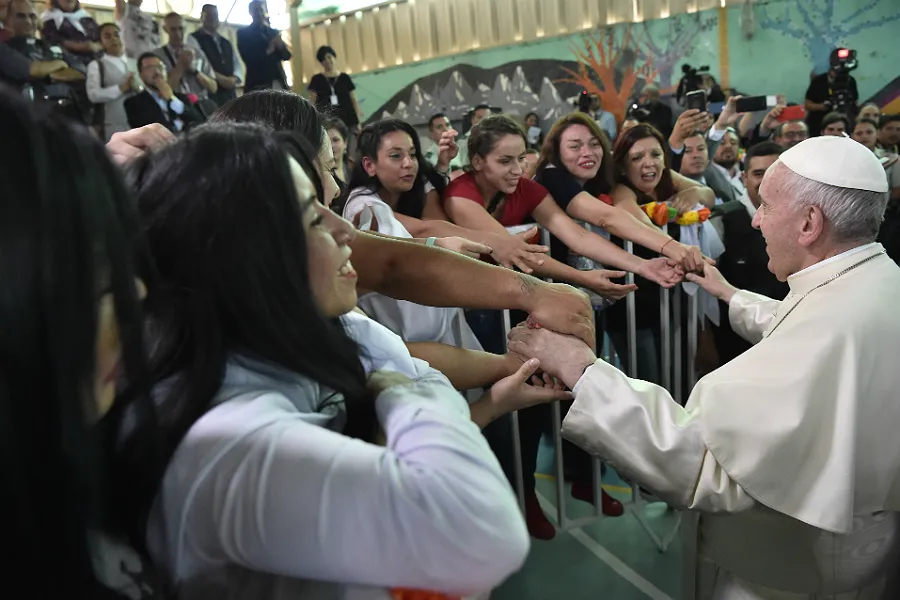
Santiago, Chile, Jan 16, 2018 / 12:55 pm (CNA/EWTN News).- Pope Francis visited a women’s prison in Santiago on Tuesday, telling the inmates that while at times it might seem like they have no future, they must never stop dreaming and should look for opportunities for personal growth.

“Losing our freedom does not mean losing our dreams and hopes. Losing our freedom is not the same thing as losing our dignity,” the Pope said Jan. 16.

Because of this, he stressed the need to reject all of the “petty clichés” that tell us “we can’t change, that it’s not worth trying, that nothing will make a difference.”

“No, dear sisters! Some things do make a difference,” he said. “All those efforts we make to build for a better future – even if often it seems they just go down the drain – all of them will surely bear fruit and be rewarded.”

Pope Francis spoke to inmates at the San Joaquin women’s prison in Santiago, which was founded by religious sisters from the Congregation of the Good Shepherd.

Established in 1864 and entrusted to the sisters in 1996, the prison until 1980 had no more than 160 inmates. However, with the increase in drug trafficking and the use of narcotics, by 2000 the prison had around 1,400 inmates.

Today the prison, which has 885 spaces available, houses nearly 45 percent of all female inmates in Chile.

Francis visited the prison on his first full day in Santiago, which is part of a Jan. 15-22 visit to Chile and Peru. He gave the penitentiary a ceramic bas-relief of Our Lady from Italy.

During the encounter, he heard the testimony of Sister Nelly León, who is in charge of pastoral outreach in the prison and who lamented that the poor are disproportionately incarcerated in Chile.

He also listened to one of the inmates, Janeth Zurita, who asked forgiveness of those who have been harmed by the wrongs the imprisoned have done and spoke about the suffering of the children of inmates. “May God have mercy on all the childen whose parents are prisoners, because they have a punishment we gave them, without willing it,” she said. Zurita also asked that “we may be able to repay our debt to society without being separated from our childen.”

In his address, the Pope thanked Zurita for “coming forward and sharing your hurt with all of us, and for your courageous request for forgiveness.”

“How much we all have to learn from your act of courage and humility,” he said, and also thanked Zurita for her words on forgiveness, which serve as a reminder “that without this attitude we lose our humanity.”

He noted how many of the women at the prison are mothers, and therefore know what it means to take on a new life and bring it into the world.

“Motherhood is not, and never will be a problem. It is a gift, and one of the most wonderful gifts you can ever have,” he said, noting that in their position, the women face the very real and unique challenge of caring for the life they have created.

“You are asked to care for the future. To make it grow and to help it to develop,” he said, adding that as women, “you have an incredible ability to adapt to new circumstances and move forward.”

Children themselves are a source of strength and incentive for the future, he said, explaining that their presence is also a reminder that life must be lived for the future, and not stuck in the past.

“Today your freedom has been taken away, but that is not the last word. Not at all,” he said, and told the women to “keep looking forward. Look ahead to the day when you will return to life in society.”

Pointing to the Gospel passage in Mark in which Christ is laughed at for saying the daughter of a synagogue leader was not dead but merely asleep, the Pope said Christ “pays no attention to ridicule and never gives up,” but rather takes our hand and tells us to get up, just as he did for the little girl.

Sadly, he noted that a jail sentence can seem like just a punishment with no opportunities for personal growth. “This is not good,” he said, explaining that initiatives aimed at job training and the restoration of relationships are “signs of hope for the future.”
 
“Let us help them to grow,” he said, adding that “public order must not be reduced to stronger security measures, but should be concerned primarily with preventive measures, such as work, education, and greater community involvement.”

Francis closed his address saying life itself blooms and shows its beauty when we work hand-in-hand to make things better and open the door to “open up new possibilities.”

He greeted all those who work and volunteer at the prison, who carry out “sensitive and complex” tasks. He also spoke to the authorities at the prison, asking them to provide “the conditions needed to carry out your work with dignity. A dignity that engenders dignity.”

[…]

No Picture
News Briefs

Pope Francis’ Chile visit revives allegations against bishop

January 16, 2018 CNA Daily News 2

Santiago, Chile, Jan 16, 2018 / 11:30 am (CNA/EWTN News).- As Pope Francis began his visit to Chile, a Vatican spokesman has voiced “maximum respect” for the rights of protesters continuing their three-year opposition to a bishop’s appointment, but the Pope will not meet with them.
 
The subject of the protests, Bishop Juan Barros Madrid of Osorno, has repeated explanations that he did not know his longtime friend Father Fernando Karadima was a sexual abuser, despite the claims of protesters alleging that Barros helped cover up Karadima’s abuse.
 
“I never knew anything about, nor ever imagined the serious abuses which that priest committed against the victims,” Bishop Barros told the Associated Press. “I have never approved of nor participated in such serious dishonest acts and I have never been convicted by any tribunal of such things.”
 
In January 2015 the Pope named Bishop Barros to head the Diocese of Osorno in southern Chile. The appointment drew objections and a call for his resignation from several priests. Dozens of protesters, including non-Catholics, attempted to disrupt his March 21, 2015 installation Mass at the Osorno cathedral.

 Days later, Archbishop Fernando Chomali Garib of Concepcion said that Pope Francis had told him that there was “no objective reason at all” that the bishop should not be installed. The pontiff had been kept up-to-date on the situation.

On March 31, 2015, the Vatican’s Congregation for Bishops also released a statement, saying that the office had “carefully examined the prelate’s candidature and did not find objective reasons to preclude the appointment.”
 
The then-apostolic nuncio to Chile, Archbishop Ivo Scapolo, said that all information about Barros was passed on to Pope Francis. Most of the people in the church were not protesters, but “people who love their bishop,” the nuncio said.
 
Decades previously, Bishop Barros had been a close friend to Father Fernando Karadima, an influential Santiago-area priest who fostered the vocations of about 40 priests, including Barros.
 
When reports of sexual abuse and other scandal surrounding Karadima surfaced, Bishop Barros was among the prelates who did not believe the accusations. A civil lawsuit against the priest was dismissed on the grounds that his alleged behavior was beyond the statute of limitations.
 
In February 2011, however, the Congregation for the Doctrine of the Faith finished its investigation with the conclusion that the priest was guilty. At the age of 84, Karadima was sent to a life of solitude and prayer.
 
Bishop Barros said he had already been distancing himself from the priest before allegations surfaced, because he had become “ill-tempered.”
 
“The pain of the victims hurts me enormously, I pray for those that carry this pain with them today,” he said in a 2015 letter to the faithful of the Diocese of Osorno ahead of his installation.
 
On May 6, 2015, five months after Barros was appointed to lead the Diocese of Osorno, Deacon Jaime Coiro, general secretary of the Chilean episcopal conference, told Pope Francis that the Church in Osorno “is praying and suffering for you.”

“Osorno suffers, yes,” Pope Francis said, “for silliness.”

“The only accusation against that bishop was discredited by the judicial court,” the Pope told Coiro, according to a video of the conversation released by Chile’s Ahora Noticias.

“Think with your head, and do not be carried away by the noses of the leftists, who are the ones who put this thing together,” the Pope added.

<iframe width=”560″ height=”315″ src=”https://www.youtube.com/embed/8MJ-arsR7kE” frameborder=”0″ allow=”autoplay; encrypted-media” allowfullscreen></iframe>

Three of Karadima’s victims have accused Barros of covering up for the priest, an allegation not supported by the Vatican investigation. The most well-known of these accusers, former seminarian Juan Carlos Cruz, lives in the U.S. and has served as a leading communications executive for the DuPont company.
 
Cruz charged that Karadima sexually abused him in the 1980s and claimed that Barros and other bishops trained by Karadima were aware of the abuse and even witnessed it, the Associated Press says.
 
On Jan. 11 the Associated Press said a confidential letter from the Pope to the Chilean bishops’ conference, dated Jan. 31, 2015, acknowledged some Chilean bishops’ concerns about the appointment. The Pope reportedly said that the apostolic nuncio in 2014 had asked Barros to resign as bishop to Chile’s armed forces and to take a sabbatical before assuming any other responsibility as a bishop.
 
The Pope’s letter said Barros was informed that similar approach was planned for two other bishops trained by Karadima, but the bishop was not to share this information. Barros allegedly created “a serious problem” when he named these two bishops in his letter stepping down as military bishop and “blocked any eventual path” to remove these bishops from controversy.
 
Burke, the Vatican spokesman, declined to comment to the AP regarding the Pope’s 2015 letter. For his part, Barros said he knew nothing of the letter.
 
Pope Francis is visiting Chile and Peru during a trip spanning Jan. 15-22. The papal visit to Chile has drawn some violent opposition.
 
At least six Catholic churches in the country were attacked in apparent protest of the visit.

Three Catholic churches in the capital of Santiago were attacked or vandalized by unknown assailants Jan. 12. A firebomb at Saint Elizabeth of Hungary Parish in Santiago’s Estación Central district included a death threat against the Pope.
 
“Pope Francis, the next bombs will be in your cassock,” said a pamphlet left behind.
 
Two other chapels in the city also suffered damage, including broken windows and doors.
 
Other pamphlets left behind appeared to object to the Church, saying “We will never submit to the dominion they want to exercise over our bodies, our ideas and actions because we were born free to decide the path we want to take.” The messages appeared to support “autonomy and resistance” for the Mapuche, the largest indigenous group in the country. Many Mapuche live in the Aurancia region, where Pope Francis will visit.
 
Since Chile’s 19th-century military conquest that incorporated the region, many Mapuche communities have sought the return of ancestral lands, respect for their cultural identity, and sometimes autonomy.
 
A fourth church – Christ the Poor Man Shrine – was targeted by a bomb threat and was subsequently investigated by a bomb squad. Some evangelical Protestant churches were also targeted.
 
The morning after the attacks, a group of protesters stormed Chile’s apostolic nunciature before police arrived and evicted them.
 
Roxana Miranda, head of an activist group that protest high mortgage rates, claimed responsibility for the protest and said it was motivated by objections to the cost of the Pope’s visit to the country.

[…]

No Picture
News Briefs

Pope lands in Chile with plea for forgiveness after abuse scandal

January 16, 2018 CNA Daily News 1

Santiago, Chile, Jan 16, 2018 / 05:03 am (CNA/EWTN News).- In the first official encounter of his apostolic visit to Chile, Pope Francis expressed his shame and sorrow for the child sexual abuse crisis that occurred at the hands of clergy of the Catholic Church.  

“I feel bound to express my pain and shame at the irreparable damage caused to children by some ministers of the Church,” the Pope said Jan. 16.

Speaking to the country’s civil leaders, he said “I am one with my brother bishops, for it is right to ask for forgiveness and make every effort to support the victims, even as we commit ourselves to ensuring that such things do not happen again.”

The Church in both Chile and Peru has faced strong fallout from sexual abuse scandals, which have damaged the Church’s image and created a strong distrust of the hierarchy.

The major case in Chile is that of Fr. Fernando Karadima, who once led a lay movement from his parish in El Bosque. He was found guilty of sexually abusing minors in 2011.

The Pope’s meeting with the Chilean authorities, civil society, and diplomatic corps, was his first official encounter during his apostolic trip to Chile and Peru Jan. 15-22.

He will be in Chile through Jan. 18, visiting Santiago, Temuco, and Iquique. During the visit he will have lunch with the Mapuche residents of the Araucania region, and visit the Pontifical Catholic University of Chile.

From Chile he will go to Peru, visiting Lima, Puerto Maldonado, and Trujillo. He will meet with indigenous Amazonians and pray before the relics of Peruvian saints before returning to Rome Jan. 22.

In his speech the Pope said that the future of Chile depends on the ability of both its people and leaders to listen to one another, preserving the country’s ethnic, cultural and historical diversity from “all partisan spirit or attempts at domination,” which threaten the common good.

He enumerated the different groups of people he believes most need to be listened to: children, the unemployed, native peoples, migrants, youth, and the elderly.

“It is necessary to listen,” he said. “To listen to the native peoples, often forgotten, whose rights and culture need to be protected lest that part of this nation’s identity and richness be lost.” As well as migrants, who come to this country in search of a better life.

We should also listen to young people and their desire for greater opportunities, he continued, especially in education, “so that they can take active part in building the Chile they dream of.”

Quoting the Te Deum homily of deceased Chilean Cardinal Silva Henríquez, the Pope said that “We – all of us – are builders of the most beautiful work: our homeland. The earthly homeland that prefigures and prepares the (heavenly) homeland that has no borders.”

The Pope encouraged people to strive to make Chile a place that welcomes everyone, and where everyone feels called to join in helping to build up the nation.

“Yours is a great and exciting challenge: to continue working to make this democracy, as your forebears dreamed, beyond its formal aspects, a true place of encounter for all,” Francis said.

He quoted the words of St. Alberto Hurtado, a Chilean Jesuit who died in 1952 and was canonized in 2005, who said: “A nation, more than its borders, more than its land, its mountain ranges, its seas, more than its language or its traditions, is a mission to be fulfilled.”

A visit to the saint’s shrine is part of the Pope’s schedule at the end of the day, during a private meeting he’ll have with local Jesuits.

“Each new generation must take up the struggles and attainments of past generations, while setting its own sights even higher,” he said. “Goodness, together with love, justice and solidarity, are not achieved once and for all; they have to be realized each day.”

“It is not possible to settle for what was achieved in the past and complacently enjoy it, as if we could somehow ignore the fact that many of our brothers and sisters still endure situations of injustice that none of us can ignore.”

[…]

No Picture
News Briefs

On flight to Chile, Pope gives journalists photo showing ‘fruits of war’

January 15, 2018 CNA Daily News 1

Aboard the papal plane, Jan 15, 2018 / 05:17 pm (CNA/EWTN News).- En route from Italy to Chile on Monday, Pope Francis told journalists of his concerns about war, and especially the use of nuclear weapons, giving each of them a photo of a child in Nagasaki.

On the back of the photo is printed “the fruits of war”, and it is signed by Pope Francis.

“I was moved when I saw this photo, and I dared to write only ‘the fruits of war’. I thought of printing it to distribute it because it is more moving than 1,000 words,” the Pope told journalists Jan. 15.

The photo is of a boy carrying the body of his brother while in line at a crematorium in Nagasaki in the wake of the Aug. 9, 1945 atomic bombing of the city by the US.

Pope Francis made his remarks at the beginning of the nearly 16 hour flight.

He also noted that he studied in Chile for a year and knows the country well. He will also be visiting Peru, where he has visited two or three times.

The Pope will be in Chile through Jan. 18, visiting Santiago, Temuco, and Iquique. He will have lunch with the Mapuche residents of the Araucania region, and visit the Pontifical Catholic University of Chile.

From Chile he will go to Peru, visiting Lima, Puerto Maldonado, and Trujillo. He will meet with indigenous Amazonians and pray before the relics of Peruvian saints before returning to Rome Jan. 22.

[…]

No Picture
News Briefs

Chile: another church firebombed a day before pope’s visit

January 15, 2018 CNA Daily News 0

Santiago, Chile, Jan 15, 2018 / 04:00 pm (CNA).- On the eve of Pope Francis’ visit to Chile, an attack on a church was reported in the city of Melipilla, an hour outside of Santiago. This was the sixth attack on Catholic
churches in protest of the pontiff’s visit.

Local media reported that around 1:00 am on Sunday, masked individuals threw an explosive at St. Augustine Church, damaging the main door and part of the entrance. Police and firemen responded to the scene.

<blockquote class=”twitter-tweet” data-lang=”en”><p lang=”es” dir=”ltr”>ACTUALIZADO + FOTOS | Iglesia de Melipilla sufre ataque incendiario en la víspera de la visita papal <a href=”https://t.co/PUveGqBmHG”>https://t.co/PUveGqBmHG</a> <a href=”https://t.co/3ke44Bj3UM”>pic.twitter.com/3ke44Bj3UM</a></p>&mdash; BioBioChile (@biobio) <a href=”https://twitter.com/biobio/status/952448642266345474?ref_src=twsrc%5Etfw”>January 14, 2018</a></blockquote>
<script async src=”https://platform.twitter.com/widgets.js” charset=”utf-8″></script>

The attackers also spray painted the sidewalk with this message: “The only church that illuminates is the one that burns, the one in flames. Hah-Hah No to the Pope.”

The Church in Chile has been plagued by protests, many centering around the case of Father Fernando Karadima a once-popular Chilean priest convicted  by the Church in 2011 of sexually abusing minors but, controversially, not laicized. Other protests have been related to the political status of the Mapuche, Chile’s largest indigenous group. Still another group of protesters attacked the apostolic nunciature, the Vatican Embassy in Chile, on Jan. 12, opposing the cost of the papal visit to the Chilean government.

The Diocese of San José condemned the Melipilla attack in a Facebook post, and noted that “Saint Augustine Church is the only building on the national register of historical places in the city of Melipilla.”

“We repudiate this act of hatred against the faith. Today we ask you to raise up a special prayer for those who committed this act of clear religious intolerance,” the diocese said.

Bio Bio Radio reported that the fire did not do a lot of damage and there were no injuries, since the church was closed down after a 2010 earthquake and is still being remodeled.

Local police are conducting an investigation to find the whereabouts of those involved.

Prior to this attack, three other Catholic churches in Santiago were attacked in the early hours of Jan. 12 and suspicious devices were found at two others.

The Archdiocese of Santiago expressed its deep sorrow for those attacks, and said that they do not represent “the feeling of the vast majority of the population.”

“We are deeply pained by these incidents which contradict the spirit of peace which animates the pope’s visit to the country,” the archdiocese said.

This article was originally published by our sister agency, ACI Prensa. It has been translated and adapted by CNA.

[…]

No Picture
News Briefs

How inmates at a Chilean women’s prison are preparing for the Pope

January 13, 2018 CNA Daily News 0

Santiago, Chile, Jan 13, 2018 / 04:00 am (ACI Prensa).- As Pope Francis prepares to visit Chile next week, the inmates at San Joaquin Women’s Penitentiary Center in Santiago are cleaning, decorating, and preparing for what they believe is a providential papal visit.

The Pope will visit the prison on Jan. 16, making a 40-minute stop to meet with the women there.

Ever since the Holy Father’s visit was confirmed, the 620 women incarcerated in the prison – serving sentences for drug trafficking, homicide, robbery or other crimes – have been planning for the encounter.

“People are suffering here, there’s a lot of pain, and that the Pope would come and remember us means that God has remembered us,” said inmate Nelly Dominguez. “I believe it’s the providence of God, nothing less.”

Dominguez is serving a 15-year sentence for drug trafficking. “For me, this visit is a before-and-after,” she told ACI Prensa. “Not just in my life but in the lives of all the people here.”

“I am in the process of changing, I’m working on my spiritual life, I intend to change,” she said.

“I think good things are coming for Chile,” she added, describing the Pope’s upcoming visit as “a very great blessing from God.”

Dominguez and the prison’s other inmates are making the paper decorations for the garlands that will decorate the gymnasium where the Pope will meet with the prisoners. They are constructing 7,000 paper doves and 5,000 flowers.

As part of the program, the prison choir will perform a song composed by the inmates. Entitled “Shepherd who smells of the sheep,” the song talks about life in the prison, and the pain and hopes of the women.

Sister Nelly León, a member of the Congregation of the Good Shepherd, works in the prison. She told ACI Prensa that the time of preparation is one of “a lot of joy, festivity and gladness. It’s a second Advent for us.”

The religious sister said her community has created worksheets entitled “From Forgiveness to Peace” to help the prison population spiritually prepare.

The inmates “feel a special connection with Jesus who welcomes them,” Sister León said. She compared the Pope traveling through Chile and stopping at the prison with Jesus stopping to encounter people at various moments of his earthly life, such as Martha and Mary, the woman caught in adultery, the Samaritan woman at the well, and Veronica during the Way of the Cross.

Sister León will deliver a welcome speech to Pope Francis. She said the first thing she will do is thank the pontiff for “showing his concern for incarcerated women, because he has shown his concern for the poorest of the poor, and because his presence dignifies the lives of people in prison.”

Staff members at the women’s prison agreed that the encounter will be special for everyone involved.

Petty Officer Alicia Contreras, who participates in the prison ministry, said she thinks the visit with renew the faith of all those who participate.

Chile’s national police chief, Jaime Rojas, expressed his hope that the visit will reinforce the country’s commitment to reintegrating released prisoners back into society through education, work and spiritual support. He added that he hopes the visit will “shake up the consciences of Chileans.”

This article was originally published by our sister agency, ACI Prensa. It has been translated and adapted by CNA.

[…]

No Picture
News Briefs

Churches attacked in Chile ahead of Pope’s visit

January 12, 2018 CNA Daily News 1

Santiago, Chile, Jan 12, 2018 / 02:42 pm (ACI Prensa).- Just days before Pope Francis’ visit to Chile, three Catholic churches in the capital of Santiago were attacked by unknown assailants.  

A fourth church – Christ the Poor Man Shrine – was targeted by a bomb threat and was subsequently investigated by a bomb squad.

Hours before, Saint Elizabeth of Hungary Parish in the Estación Central district was fire bombed. The arsonists fled the scene, leaving behind messages against the Holy Father’s visit to the country.

“Pope Francis, the next bombs will be in your cassock,” said a pamphlet left behind.

The community of priests that live at Saint Elizabeth’s and the neighbors immediately worked to extinguish the fire, which damaged the entrance doors and several windows.

Two other chapels in the city also suffered damage, including broken windows and doors.

At some of the churches, pamphlets were left behind, saying, “We will never submit to the dominion they want to exercise over our bodies, our ideas and actions because we were born free to decide the path we want to take…We are attacking with the fire of battle, making your disgusting morals explode.”

The pamphlets also called for “autonomy and resistance” in the Mapuche conflict. The Mapuche are the largest indigenous group in the country. Many of them live in the region of Araucania, which Pope Francis will visit during his trip.

Chile incorporated Araucania by military conquest between 1861 and 1883, resulting in a major rift between the government and the Mapuche people. The tension continues to this day, with Mapuche communities calling for the return of ancestral lands, respect for their cultural identity, and in some cases, autonomy.

“This was a cowardly act. I’m upset, pained, because this is a poor community, a struggling community: these are people who don’t know the consequence of what they’re doing,” the parochial vicar Fr. Marcelo Cabezas lamented.

“On the other hand, if there are attacks, it’s because we’re having an impact as Catholics,” he said.

No one was injured in any of the attacks. Police investigators are on location to determine if the attacks were related.

Deputy Secretary of the Interior, Mahmud Aleuy, visited the damaged churches and said the Government of Chile will prosecute the offenders when found.

The Archdiocese of Santiago released a statement saying, “We are deeply pained by these incidents, which contradict the spirit of peace that animates the Pope’s visit to the country.”

“With humility and serenity we call on those who have committed these acts, which we consider in no way to represent the feeling of the vast majority of the population, to reflect on the need that exists for respect and tolerance among all, to build a homeland of brothers.”

Later in the morning, a group of protestors stormed the apostolic nunciature, before the police arrived and evicted them from the building.

Roxana Miranda, head of wrote a group that protests high mortgage rates, took responsibility for the nunciature protest in a Twitter statement. She said the group was protesting the cost of the papal visit.

This article was originally published by our sister agency, ACI Prensa. It has been translated and adapted by CNA.

[…]

No Picture
News Briefs

Why Pope Francis will visit Chile’s Araucania region

January 10, 2018 CNA Daily News 0

Temuco, Chile, Jan 10, 2018 / 03:03 pm (ACI Prensa).- Pope Francis will spend a day in Temuco, the capital of a Chilean region with a large indigenous population, during his Jan. 15-18 visit to the nation. The city’s bishop has said the Pope decided to come to the area because it represents Chile’s peripheries.

“If we look at where the Pope likes to go when on a visit, it is precisely the borders, the existential borders, where there is pain, where there is suffering, where there are wounds, where there is poverty, Bishop Hector Vargas Bastidas of Temuco told ACI Prensa, CNA’s Spanish-language sister news agency.

Temuco is the capital of Araucania, a region in south-central Chile where one-third of the population is ethnic Mapuche, who are by far the country’s largest indigenous group.

Bishop Vargas offered the indigenous population, their conflict with the Chilean state, and the region’s poverty as three reasons Pope Francis has chosen to visit Temuco.

During his Jan. 17 visit to the city, the Pope will say Mass at Maquehue Airport and will lunch with inhabitants of Araucania at the Madre de la Santa Cruz house.

Bishop Vargas explained that some 200,000 Mapuche people live in Araucania and live profoundly  “their Mapuche identity, their worldview.”

While many Mapuche have moved to Santiago, the Chilean capital, many who have remained in Araucania live in their communities led by and encouraged by their ancestral authorities.

“There is a very great richness there,” the bishop explained. “This is a region where the issue of inter-culturalism is lived out and understood more and more, so this is a very important reason that the Pope certainly considered in planning his visit.”

He cited the Mapuche conflict as a second reason for Pope Francis’ visit.

Chile incorporated Araucania by military conquest between 1861 and 1883, and the manner of the region’s “pacification” led to “a major rift  between the government and the Mapuche people,” Bishop Vargas explained.

“A very great historic debt was created with this people, who are still waiting for this debt to be rectified,” he said.

Mapuche communities ask for the return of ancestral lands, respect for their cultural identity, and even autonomy.

Even though the majority of those involved in trying to settle the conflict are working to find solutions, the bishop pointed out that some radicalized groups in the minority “unfortunately think that this can be solved or that much more rapid progress can be made through violence.”

From 2014 through 2017, thirteen Catholic churches were burned by these groups.

“The violence has only brought more poverty, new injustices, and new suffering,” the Bishop of Temuco lamented. In 2016 he took on the responsibility of acting as a facilitator in talks between the government and the Mapuche people.

Finally, Bishop Vargas explained that among the country’s 15 regions, Araucania “ranks first in poverty in Chile.”

According to a 2015 government survey, 23.6 percent of the people in this region are living below the poverty line, the highest rate in the country. And a 2017 survey showed an unemployment rate in the region of 8.4 percent, the nation’s second highest.

Given this situation, Bishop Vargas said that “the transformation that one and all hope for in Araucania is going to come only if all of us who live here changes our hearts.”

“First of all, we have to change our hearts, we have to grow in humanity; then, laws and decrees will have their place. What people want will not be achieved if first we don’t undergo a conversion and a major transformation, and that is something only the Lord can give,” he concluded.

<iframe width=”560″ height=”315″ src=”https://www.youtube.com/embed/j0ky1F4B2bc?rel=0″ frameborder=”0″ allow=”autoplay; encrypted-media” allowfullscreen></iframe>


This article was originally published by our sister agency, ACI Prensa. It has been translated and adapted by CNA.

[…]