No Picture
News Briefs

The Church needs you, Francis tells contemplative sisters in Peru
January 21, 2018 CNA Daily News 0

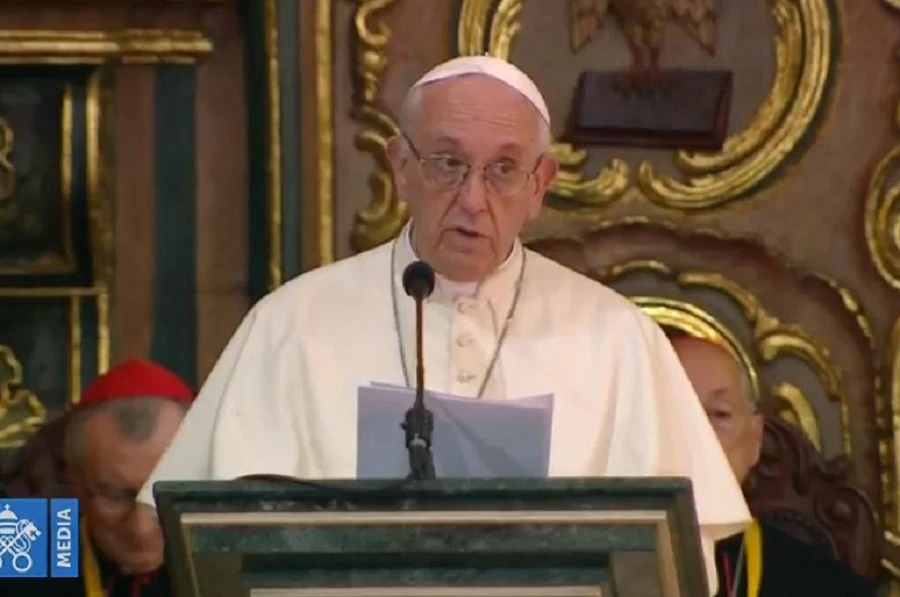
Lima, Peru, Jan 21, 2018 / 08:49 am (CNA/EWTN News).- Speaking to contemplative women religious Sunday, Pope Francis said that they aren’t second-class, but a necessary part of the Church, and asked them to continue to pray on behalf of the Church and sinners.

“Sisters, know something: The Church doesn’t tolerate you, it needs you!” the Pope said in off-the-cuff remarks Jan. 21.

“Be beacons of light. And pray for the Church, for the shepherds, for those who hurt others, and those who exploit their siblings. And going on with the list of sinners, don’t forget to pray for me.”

Pope Francis spoke during a homily at the end of praying “Terce,” the prayer of the Liturgy of the Hours sung or said at 9a.m., with contemplative women religious in Lima’s Shrine of the Lord of Miracles.

The prayer took place on the last day of his Jan. 18-22 apostolic visit to Peru, which followed a three-day visit to Chile. He will return to Rome Jan. 22.

In his homily he quoted St. Therese of the Child Jesus, who once wrote in a letter: “I was certain that love subsumes in itself all vocations, that love is everything, encompassing all times and places, in a word, that love is eternal…in the heart of the Church, who is my Mother, I will be love.”

“To be love! This means being able to stand alongside the suffering of so many of our brothers and sisters,” Francis continued. “In this way, your cloistered life can attain a missionary and universal outreach and play ‘a fundamental role in the life of the Church.’”

“For this very reason, we can state that cloistered life neither closes nor shrinks our hearts, but rather widens them in our relationship with the Lord,” he explained. “May intercession for those in need be the hallmark of your prayer.”

The Pope also noted the words of St. Paul in his Letter to Romans, where he says that we have received a spirit of adoption, making us “children of God.”

“Those few words sum up the richness of every Christian vocation: the joy of knowing we are God’s children,” Francis said. This is the experience that nourishes our lives, that seeks always to be a pleasing response to God’s love. How important it is to renew this joy day by day!”

Following his meeting with women religious, Pope Francis made a stop at the Cathedral of Lima to pray in front of relics of five Peruvian saints.

During the stop he prayed in silence for a few minutes, before offering a prayer together with those present, stating his thanksgiving for the gifts the Lord has bestowed on the Church in Lima, especially the gift of holiness, “that has flourished in our land.”

“Our Archdiocesan Church has been made fruitful by the apostolic labors of Saint Turibius of Mogrovejo, enlarged by the prayer, penance and charity of Saint Rose of Lima and Saint Martin de Porres, adorned by the missionary zeal of Saint Francisco Solano and the humble service of Saint Juan Macías,” he prayed.

After the prayer and benediction, Francis met with the bishops of Peru in the chapel of Lima’s chancery.

In his speech to bishops he focused on the 16th century saint from Spain, St. Turibius of Mogrovejo, who served as the archbishop of Lima for 25 years, and is known for having upheld the rights of Peru’s indigenous peoples.

He was canonized in 1726, making him one of the first canonized saints of the Americas. During his time as archbishop, Turibius made three different visitations to the land of his diocese, crossing rugged and dangerous terrain.

“He went out to encounter everyone, along paths that, in the words of his secretary, were meant more for goats than for people,” Francis said.

“He knew that this was the one way to be a pastor: to be close to his own, dispensing the sacraments, and he constantly exhorted his priests to do the same,” not just with words, but as a witness “in the front lines of evangelization.”

The Pope noted that when St. Turibius was visiting and living with his people he learned to speak their languages so that they could really understand the Gospel, and it could touch their hearts.

This is a good lesson for bishops of the 21st century too, he pointed out, who not only sometimes need to learn new languages in the traditional sense, but also to learn the language of the digital age, in order to communicate well with young people, families and children.

St. Turibius also believed that “there could be no evangelization without charity,” Francis said. “He knew that the supreme form of evangelization is to model in our own lives the self-giving of Jesus Christ, out of love for every man and woman.”

“Dear brothers, work for unity,” Francis concluded. “Do not remain prisoners of divisions that create cliques and hamper our vocation to be a sacrament of communion.”

“Remember: what was attractive about the early church was how they loved one another. That was – and is and always will be – the best way to evangelize.”

At the end of the meeting, the Pope also held a lengthy question-and-answer session with the bishops.

[…]

No Picture
News Briefs

Do not become ‘professionals of the sacred,’ Pope tells Peruvian priests, religious

January 20, 2018 CNA Daily News 1

Lima, Peru, Jan 20, 2018 / 02:40 pm (CNA/EWTN News).- Pope Francis met with Peruvian priests and religious Saturday, telling them that a sense of humor is a good remedy for the temptation to clerical self-importance.

“John [the Baptist] embodies the awareness of a disciple conscious that he is not, and never will be, the Messiah, but only one called to point out the Lord’s presence in the life of his people,” the Pope said Jan. 20.

Pointing to the passage in John’s Gospel in which John the Baptist tells his disciples to “behold the Lamb of God” as he sees Jesus passing by, Francis noted that while John was a good and faithful disciple, he “was waiting for someone greater than himself.”

Those who are consecrated are not called to replace the Lord by their missions and activities, but rather, “to work with the Lord, side by side, never forgetting that we do not replace him.” Knowing they are not the Messiah, he said, frees clerics and religious “from thinking that we are overly important or too busy.”

While this temptation is real and is often present in in communities, Francis offered a remedy: laughter.

“Learning to laugh at ourselves gives us the spiritual ability to stand before the Lord with our limitations, our mistakes and our sins, but also our successes, and the joy of knowing that he is at our side,” he said.

“Laughter saves us from the self-absorbed promethean neopelagianism of those who ultimately trust only in their own powers and feel superior to others,” he said, and urged those present to conduct a “spiritual test” to see whether or not they are able to laugh at themselves.  

He told them to laugh in their community, but never “at the community or at others,” and to be “on guard against people so important that they have forgotten to smile in their lives.”

Pope Francis spoke to some 1,000 priests, seminarians and religious during a Jan. 20 trip to the Peruvian beach town of Huanchaco, where he traveled as part of his Jan. 18-21 visit to Peru, following a three-day visit to Chile.

He was greeted by Archbishop Jose Antonio Eguren Anselmi S.C.V., who oversees the dioceses of Piura and Tumbes.  Anselmi is a member of the Sodalitium Christianae Vitae, which earlier this month received a “Commissioner” from the Pope tasked with governing the community as they carry out reform following revelations of serial abuse by their founder, Luis Fernando Figari, in 2015.

The encounter with priests, religious and seminarians from all over Peru took place at the seminary college of Trujillo. According to statistics provided by the Holy See Press Office, there are currently some 3,361 priests in Peru, including diocesan and religious; 65 permanent deacons; 422 professed male religious and 5,568 professed women religious.

In his speech, Pope Francis told attendees that their vocation is one of “remembrance,” because it points to the fact that neither life, nor faith, nor the Church began with any one of them.

Rather, he said “remembrance looks to the past in order to discover the sap that nourished the hearts of disciples for centuries, and thus comes to recognize God’s presence in the life of his people.”

One of the virtues of this remembrance, he said, is a “joyful self-awareness” which recognizes, like John the Baptist, that Jesus is the Messiah and we are simply his servants, called to both follow Jesus’ example and continue his work of service to others, which is “the source of our joy.”

Another aspect of this remembrance is what Francis referred to as “the time of the call,” meaning the first moment in which God’s call to their vocation was felt.

In his Gospel, John remembers the exact hour in which his life changed by meeting Jesus, saying “it was about the tenth hour,” the Pope said, adding that a single encounter with Jesus “changes our lives, it establishes a ‘before’ and an ‘after’.

He urged attendees to remember the day when they first realized that “the Lord expected something more of us.”

If this moment is forgotten, “we forget our origins, our roots,” he said, “and by losing these basic coordinates, we lose sight of the most precious part of our lives as consecrated persons: the Lord’s gaze.”

“We do well to remember that our vocations are a loving call to love in return, and to serve,” he said, and quoting the Book of Deuteronomy, said that “if the Lord fell in love with you and chose you, it was not because you were more numerous than the others, for you are the least of peoples, but out of pure love!”

Pope Francis also pointed to the influence of popular piety on the vocational call, noting that in Peru, where colorful processions and large Masses marking special feast days are common, expressions of this piety “have taken on the most exquisite forms and have deep roots in God’s simple and faithful people.”

Because of this, he told those present “not to forget, much less look down on, the solid and simple faith of your people. Welcome, accompany and stimulate their encounter with the Lord.”

“Do not become ‘professionals of the sacred’ by forgetting your people, from whose midst the Lord took you. Do not lose your remembrance and respect for those who taught you how to pray,” he said, explaining that to remember the moment of one’s call is to celebrate Christ’s entry into their lives.

Remembrance, joy and gratitude, are the three “weapons” that best defend against “all vocational pretense,” he said, because “grateful awareness enlarges the heart and inspires us to service.”

Francis then reflected on the “contagious joy” of one’s vocation, which he said is another virtue of the “remembrance” he spoke of.

Pointing to the day’s Gospel, he noted that Andrew, who was one of the disciples of John the Baptist that followed Jesus on that first day, returned home after spending time with Jesus and told his brother Simon Peter what he experienced, saying “we have found the Messiah.”

“Faith in Jesus is contagious; it cannot be restrained or kept within,” he said, explaining that Andrew begins his mission with those closest to him by “radiating joy,” prompting those around him to also follow Jesus.

Joy, he said, “is the surest sign that we have discovered the Messiah” and is constantly present in the hearts of the apostles.

This joy is meant to be shared and so opens us to others, he said, adding that in the “the fragmented world in which we live, a world that can make us withdrawn, we are challenged to become builders and prophets of community.”

No one is saved alone, he said, stressing that isolation and fragmentation are not things that happen only “out there” in the world, but “divisions, wars and isolation are found within our communities, and what harm they bring us!”

Jesus sends his disciples to build communion and unity, however, often times the opposite happens, and “we go about this by displaying our disunity and, worse yet, trying to trip each other up,” Francis said, explaining that to build unity “does not mean thinking everyone is the same, or doing things always the same way.”

“It means discerning what everyone has to offer, respecting their differences, and acknowledging the gift of charisms within the Church, knowing that while each of us contributes what he or she has, we also need one another,” he said.

The Pope then cautioned against the temptation of the “only child,” who wants everything for themselves since there is no one to share with.

“Only the Lord has the fullness of the gifts; only he is the Messiah,” he said, and urged those in positions of authority to “please not…become self-referential.”

“Try to care for your brothers and sisters; try to keep them happy, because happiness is contagious,” he said. “Do not fall into the trap of an authority that turns into authoritarianism by forgetting that its mission is primarily one of service.”

Francis closed his speech thanking attendees for their presence, and prayed that “this ‘deuteronomic’ remembrance make us more joyful and grateful to be servants of unity in the midst of our people.”


[…]

No Picture
News Briefs

When storms come, have faith in Jesus, Pope tells Catholics in Peru

January 20, 2018 CNA Daily News 0

Huanchaco, Peru, Jan 20, 2018 / 07:55 am (CNA/EWTN News).- In a homily Saturday, Pope Francis spoke about the natural disasters Peru experienced over the last year, praising the way in which Peruvians joined together to help one another during these difficult moments.

“I know that, in the time of darkness, when you felt the brunt of the [storm], these lands kept moving forward,” the Pope said during Mass near Trujillo, Peru Jan. 20.

Like the five wise virgins in the parable in the day’s Gospel, the people of Peru were prepared with “the oil needed to go out to help one another like true brothers and sisters,” he continued. “You had the oil of solidarity and generosity that stirred you to action, and you went out to meet the Lord with countless concrete gestures of support.”

The Mass, which took place in Huanchaco, a beach town outside the city of Trujillo, was part of Pope Francis’ Jan. 18-21 visit to Peru.

In his homily he referred to the “Niño,” or “Coastal El Niño,” the name given to a weather phenomenon off the coast of Peru and Ecuador, which began in December 2016.

The pattern caused warmer-than-usual water temperatures off the coasts of the two countries, which in turn triggered heavy rainfalls in the mountains.

The excess run-off from the rains caused severe flooding and mudslides, devastating parts of Peru, particularly in the north. Trujillo, Peru’s third most populated city, was one of the worst hit after a period of heavy rains last March caused mudslides and flooding directly affecting around 800,000 people and killing almost 100.

Francis encouraged Peruvians not to lose heart during these times of trials, but to use this Eucharistic celebration as an opportunity to unite their suffering to Christ’s suffering on the cross.

“These times of being ‘buffeted,’” he said, “call into question and challenge our strength of spirit and our deepest convictions. They make us realize how important it is to stand united, not alone, and to be filled with that unity which is a fruit of the Holy Spirit.”

Many people are still suffering from the damage caused by “Coastal El Niño,” the Pope noted. And it’s possible these difficulties have caused their faith to waver.

If this is the case, “we want to unite ourselves to Jesus,” he said, because “[Jesus] knows our pain and our trials; he endured the greatest of sufferings in order to accompany us in our own trials. The crucified Jesus wants to be close to us in every painful situation, to give us a hand and to help lift us up.”

Like the story of the ten virgins in the Gospel reading, who were surprised by the bridegroom’s arrival in the middle of the night, the storms of life – both the physical storms as well as other difficulties – can catch us off-guard.

In the passage, we learn that five of the virgins were prepared with oil for their lamps and five were not. “At the appointed time, each of them showed what they had filled their life with,” Francis noted, and “the same thing happens to us.”

“There are times when we realize what we have filled our lives with. How important it is to fill our lives with the oil that lets us light our lamps in situations of darkness and to find the paths to move forward!”

He commended the Peruvians for being well-prepared with the grace of the Holy Spirit, so that “in the midst of darkness, you, together with so many others, were like living candles that lighted up the path with open hands, ready to help soothe the pain and share what you had, from your poverty, with others.”

“Fill your lives always with the Gospel,” he concluded. “I want to encourage you to be a community that lets itself be anointed by the Lord with the oil of the Spirit. He transforms, renews and strengthens everything.”
 

[…]

No Picture
News Briefs

Pope Francis warns Peruvian leaders against ‘virus’ of corruption

January 19, 2018 CNA Daily News 2

Lima, Peru, Jan 19, 2018 / 03:33 pm (CNA/EWTN News).- Speaking to Peruvian authorities Friday, Pope Francis issued a stern warning against corruption, which he said has done significant harm, and snuffs out the hope offered by the country’s rich cultural and natural diversity.

“Peru is a land of hope that invites and challenges its people to unity,” the Pope said Jan. 19. However, he warned that despite the promise of the country’s many saints and the rich cultural and environmental diversity, “over this hope a shadow is growing, a threat looms.”

He warned against the destruction of natural resources and urged authorities to be “very attentive to that other, often subtle form of environmental degradation that increasingly contaminates the whole system of life: corruption.”

“How much evil is done to our Latin American people and the democracies of this continent by this social ‘virus’, a phenomenon that infects everything, with the greatest harm being done to the poor and mother earth.”

Pope Francis spoke to Peruvian President Pedro Pablo Kuczynski Godard and the country’s diplomatic corps. He spent the morning in Peru’s Amazonian region, visiting Puerto Maldonado before heading back to Lima for his meeting with civil authorities.

He will be in Peru until Jan. 21, following a three-day visit to Chile, marking his fourth tour of South America since his election.

The Pope’s visit comes after Kuczynski narrowly escaped an impeachment vote in December following revelations that a company he owned had businesses ties with the Brazilian construction firm Odebrecht, which is at the center of of one of Latin America’s biggest corruption scandals.

Odebrecht admitted in a 2016 plea bargain with the U.S. Department of Justice to paying around $800 million in bribes in 12 Latin American countries, the Guardian reports. Peru received some $29 million between 2009 and 2015.

Kuczynski is the latest Peruvian politician to get caught up in a scandal of this kind, with some former presidents currently sitting behind bars. The latest ex-president to be jailed was Ollanta Humala, who went to prison in July 2017 due to alleged money laundering in connection with Odebrecht.

In his speech, Pope Francis said efforts to fight the “social scourge” of corruption must be both recognized and supported, which is a task that involves everyone.

Hope must be defended, he said, which “requires a greater culture of transparency among public entities, the private sector and civil society. No one can be excluded from this process. Corruption is preventable and calls for commitment on the part of all.”

“I encourage and urge all those in positions of authority, in whatever sphere, to insist on this path in order to bring your people and your land the security born of feeling that Peru is a place of hope and opportunity for all, and not just for a few,” he said.

Francis praised the natural beauty and the vast biodiversity found in the country’s Amazonian region, which contains the largest tropical forest and the most extensive river system on the planet. He also drew attention to the many cultures present in Peru, which he said are the “soul of this people.”

He also noted that the country has a lot of young people, who are “the most vital gift that this society possesses,” and many saints, who have “blazed paths of faith for the entire American continent.”

Pointing to the theme of his trip, “United in Hope,” the Pope said Peru is a land of hope that invites its inhabitants to a unique unity, which he said is threatened not only by corruption, but also by environmental destruction.

Quoting his 2015 encyclical on care for our common home, Laudato si’, he said “never has humanity had such power over itself, yet nothing ensures that it will be used wisely, particularly when we consider how it is currently being used.”

“This is evident in the way that we are stripping the earth of its natural resources, without which no forms of life are possible,” he said, adding that the loss of jungles and forests means not only a loss of species and resources for the future, but also a loss of “vital relationships that could end up altering the entire ecosystem.”

To be united in hope, then, means both developing and promoting an integral ecology and listening to local populations and recognizing and respecting them as true partners in dialogue, since they know the land and the “the catastrophic effects produced, in the name of development, by many projects.”

Francis said environmental degradation is also linked to the moral degradation of communities, and pointed to black market mining as a practice which is “is destroying people’s lives.”

“This whole process of degradation brings with it and encourages organizations operating outside of legal structures; these debase so many of our brothers and sisters by subjecting them to human trafficking (a new form of slavery), irregular employment and crime … and to other evils that gravely affect their dignity and, at the same time, the dignity of the nation.”

Pope Francis closed his speech urging all those in positions of authority in every sphere “to bring your people and your land the security born of feeling that Peru is a place of hope and opportunity for all, and not just for a few.”

By doing this, a new Peru will be forged which “makes room for people of ‘all bloods’, a land in which ‘the promise of Peruvian life’ can be achieved,” he said, quoting from the Peruvian novelist José Maria Arguedas and the historian Jorge Basadre.

“I wish to renew in your presence the commitment of the Catholic Church, which has accompanied the life of this nation, in this joint effort to continue working so that Peru will continue to be a land of hope,” he concluded.

The Pope met privately with Kuczynski following his address.

[…]

No Picture
News Briefs

Meet the priest who serves an unlikely community in Peru’s Amazon

January 19, 2018 CNA Daily News 0

Puerto Maldonado, Peru, Jan 19, 2018 / 02:01 pm (CNA/EWTN News).- Fr. Pablo Zabala is a 70-year old Spanish priest, who serves in a remote part of the world: the Peruvian Amazon.

Most of the people who fill his church pews are gold miners and sex workers in Boca Colorado – an area that some are likening to the California Gold Rush. Before Fr. Zabala began serving in the Amazon, his fellow clergy compared it to Sodom and Gomorrah.

“God is in all parts,” Zabala told them, saying he felt a calling to serve with “the life of the common people,” according to the Associated Press.

Kabala, a former biologist, has lived in the Amazon for the past 24 years, 10 of which have been spent heading up the parish in Boca Colorado, part of the Madre de Dios region. Pope Francis visited the region’s capital, Puerto Maldonado, on Friday.

During his ministry, he has seen how miners support their families through their trade mainly because they have no other option for work. Poverty, Zabala noted, has driven thousands into mining or prostitution.

According to AP, miners in the area are using mercury in their pursuit of gold, which has infiltrated into the local water systems. In addition, the miners have brought with them new roadways which have tapped into the rainforest’s supply of trees.

However, Zabala has been working closely with the locals, saying he often points the women toward the witness of St. Mary Madgalene, who has been an effective inspiration for them. He also noted that the women in the town have been instrumental in building two churches.

In addition, Zabala offers the support that he can to the miners, usually in the form of a listening ear. However, on occasion, the task falls to the local priest to bury lone miners who get caught up in local conflicts.

“He’s here for the difficult moments,” said Juana Roque, a local woman who lives with her family in the mining camps.

Pope Francis visited the Madre de Dios region Jan. 19, meeting with indigenous Amazonians, the people of Puerto Maldonado, and the community of a home for orphaned children.

While meeting with members of the Amazonian community, he handed out copies of his 2015 encyclical Laudato si’ and noted that “the defense of the earth has no other purpose than the defense of life.

He also spoke about desperations of poverty which has led many to seek gold in the Amazon’s mines. However, he warned that gold can turn into “a false god that demands human sacrifices,” which can “corrupt people and institutions, and they ruin the forest.”

[…]

No Picture
News Briefs

The world needs you, Francis tells young people at children’s home

January 19, 2018 CNA Daily News 0

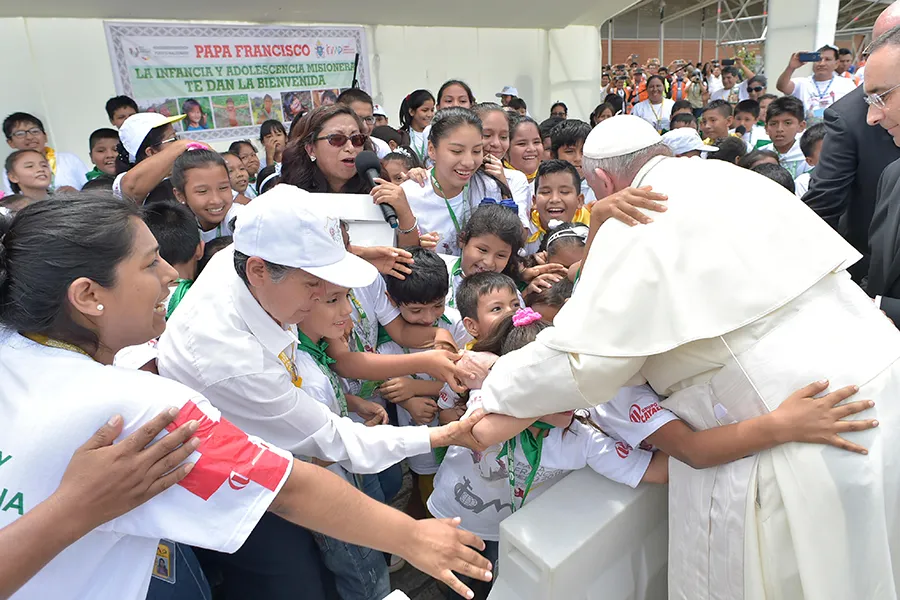
Puerto Maldonado, Peru, Jan 19, 2018 / 11:35 am (CNA/EWTN News).- Speaking to kids at a home for orphaned and abandoned children on Friday, Pope Francis said they have much to offer the world by being themselves and sharing their experiences.

“The world needs you, young men and women… and it needs you as you are. Do not be content to be the last car on the train of society, letting yourselves be pulled along and eventually disconnected. We need you to be the engine, always pressing forward,” the Pope said Jan. 19.

“Share what you learn with the world, because the world needs you to be yourselves, who you really are, and not an imitation of someone else. We need you to be authentic, young men and women who are proud to belong to the Amazonian peoples and who can offer humanity an alternative for a true life.”

Francis spoke at the “Hogar Principito” (“Little Prince Home”) in Puerto Maldonado on the second day of his Jan. 18-21 visit to Peru. The children’s home was founded in 1996 to help deal with with the high rate of neglect and child exploitation that occur in the city.

It currently houses around 40 children and adolescents, who have come from orphanages, at-risk families, or illegal mining camps. Some have been abandoned or been victims of physical, sexual, or psychological abuse.

Pope Francis met with the children and their caretakers on the basketball court of the home.

Before his speech he was greeted by the director of the home, Fr. Xavier Arbex, and listened to the testimony of Dirsey Irarica Piña, a woman who was raised in the home. He also watched performances by the children of songs and a choreographed dance.

Irarica described having been orphaned at the age of 11, and being welcomed into the Hogar Principito a couple of years later, saying the home “was ready immediately to give me the fullness of support and love … I thank my teachers and the ‘little father’ for filling this void in me. Thank you for this unconditional love which makes us feel at home.”

She now lives in Tacna, where she works and studies psychology.

In his address after listening to Irarica, the Pope referenced the recent celebration of Christmas, where our hearts were touched by the coming of the Child Jesus.

“He is our treasure. You children are his reflection, and you too are a treasure for all of us, the most precious treasure that we have, and one that we are called to guard,” Francis said.

He asked forgiveness for the times that adults have neglected to care for them and protect them as they deserve, saying how their lives demand a greater commitment and effort on the part of everyone – that we do not remain indifferent to children who suffer and are in need.

“Without a doubt, you are the greatest treasure that is ours to care for,” he underlined.

Speaking to Irarica, who gave a testimony before his speech, he said she was brave to share that sometimes she feels very hurt, and misses her father and mother.

“You told me; ‘I hope my message may be a light of hope,’” the Pope referenced. “But let me tell you something. Your life, your words, and the lives of all of you, are a light of hope.”

He said a wonderful witness “is offered by all of you young people who have travelled this road, who found love in this home and now are able to shape your own future! You demonstrate to all of us the enormous potential of each person. For these boys and girls, you are the best example to follow, a sign of hope that they will be able to do the same. We all need good role models: children need to look to the future and have positive role models.”

“Everything that you young people can do, like coming here to be with them, to play and spend time together, is important,” Pope Francis said. “Be for them, as the Little Prince says: the little stars that light up the night,” referring to the Antoine de Saint-Exupéry character for whom the children’s home is named.

The Pope went on to note how the children who came from indigenous communities may have been witness to the destruction of their home, saying: “today those woodlands have been laid waste by the intoxication of a misguided notion of progress.”

“Young people, do not be resigned to what is happening! Do not renounce the legacy you have received from your elders, or your lives and dreams.”

He also encouraged them to study and to take advantage of the educational opportunities available to them.

“Listen to your elders; value their traditions; do not curb your curiosity. Get in touch with your roots, but at the same time open your eyes to new things; bring the old and the new together in your own way,” he encouraged.

Society often needs correction and you, young people, can help greatly with this “by teaching us a way of life based on protection and care, not on the destruction of everything that stands in the way of our greed,” he said.

[…]

No Picture
News Briefs

Amazon not a ‘no man’s land’, but a treasure, Pope Francis says

January 19, 2018 CNA Daily News 0

Puerto Maldonado, Peru, Jan 19, 2018 / 10:34 am (CNA/EWTN News).- Pope Francis visited one of Peru’s most biodiverse regions Friday, telling its inhabitants that while remote, their land is not forgotten and must be cared for.

He also stressed the importance of fighting such scourges as corruption and human trafficking.

“’We are not a no man’s land.’ It is something that needs to be emphasized. You are not a no man’s land. This land has names. It has faces. It has you,” the Pope said Jan. 19 to the people of Puerto Maldonado, the capital of the Madre de Dios Region in the Amazon basin.

He was responding to comment made by a local couple, Margarita Martínez Núñez Valer and her husband Arturo, who while sharing their testimony said their land is one “that is mostly forgotten, wounded and marginalized…but we are not a no man’s land.”

Pope Francis noted that Mary also came from Nazareth, a remote and isolated village that many also considered “a no man’s land.”

Mary, he said, is not only an example but a mother, and when we have a mother, “we don’t have that terrible feeling of belonging to no one, that takes hold when our sense of belonging to a family, to a people, to a land, to our God, begins to fade.”

The Madre de Dios Region, then, “is not a land of orphans, but a land that has a Mother! And if it has a mother, it has sons and daughters, a family, a community.” While the problems might not disappear, when there is a mother, a family and a community “we certainly find the strength to confront them differently.”

He visited Puerto Maldonado on the first full day of his Jan. 18-21 visit to Peru, after spending three days in Chile. The Amazonian region is of special interest to the Pope, considering his 2015 encyclical on care for our common home, Laudato si’, and his decision to hold a Pan-Amazonian synod in 2019 to discuss the challenges the area faces.

Before meeting with the inhabitants of Puerto Maldonado, he met with members of the Amazonian community, and distributed copies of Laudato si’ which had been translated into the local languages.

Held in the city’s Jorge Basadre Institute, the encounter with the people of Puerto Maldonado began with a greeting from Bishop David Martinez de Aguirre Guinea, Vicar Apostolic of Puerto Maldonado, and the testimony of a catechist.

Francis said it is painful for him to see how some people seek to exploit the territory and therefore make Madre de Dios “a nameless land, without children, a barren land.”

Referring to what he has often dubbed the “throwaway culture,” he said this is a mentality which isn’t satisfied with simple exclusion, but continues to advance “by silencing, ignoring and throwing out everything that does not serve its interests; as if the alienating consumerism of some is completely unaware of the desperate suffering of others.”

“It is an anonymous culture, without bonds, without faces,” and which only wants to consume, he said, adding that both land and people are treated according to the same logic: “forests, rivers and streams are exploited mercilessly, then left barren and unusable,” while people are “used until someone gets tired of them, then abandoned.”

He then spoke out against the temptation of corruption and the practice of human trafficking, saying forcefully that the term slavery should be used instead: “We have become accustomed to using the term ‘human trafficking’, but in truth we should speak of slavery: slavery for work, sexual slavery, slavery for profit.”

“It is painful to see how in this land … so many women are devalued, denigrated and exposed to endless violence. Violence against women cannot be treated as ‘normal’, maintaining a culture of machismo blind to the leading role that women play in our communities. It is not right for us to look the other way and let the dignity of so many women, especially young women, be trampled upon.”

He noted that many people, desperate to escape poverty, come to the area to work in the gold mines, but he cautioned that gold can quickly turn into “a false god that demands human sacrifices.”

“False gods, the idols of avarice, money and power, corrupt everything. They corrupt people and institutions, and they ruin the forest,” he said, adding that Christ called these “demons that require much prayer to expel.”

The Pope then urged the community to continue forming movements and organizations aimed at overcoming the plagues of corruption and trafficking. “I likewise encourage you to gather, as people of faith and vibrant ecclesial communities, around the person of Jesus,” he said.

“Through heartfelt prayer and hope-filled encounter with Christ, we will be able to attain the conversion that leads us to true life. Jesus promised us true life, authentic life, eternal life. Not a make-believe life, like the one offered by all those dazzling false promises; they promise life but lead us to death.”

Salvation, he said, “is not something generic or abstract. Our Father looks at real people, with real faces and histories. Every Christian community must be a reflection of this gaze, this presence that creates bonds and generates family and community. It is a way of making visible the kingdom of heaven, in communities where everyone feels a part of the whole, where they feel called by name and encouraged to be a builder of life for others.”

Pope Francis closes his speech telling the people they live in one of “the most exuberant explosions of life on our planet,” and urged them love the land and to “realize that it belongs to you. Breathe it in, listen to it, marvel at it.”

“Fall in love with this land called ‘Madre de Dios,’ commit yourself to it and care for it,” he said, and “do not use this land as a mere disposable object, but as a genuine treasure to be enjoyed, cultivated and entrusted to your children.”

[…]

No Picture
News Briefs

Pope says accusations against Chilean bishop are ‘calumny’

January 19, 2018 CNA Daily News 2

Santiago, Chile, Jan 19, 2018 / 09:58 am (CNA/EWTN News).- At the end of his three-day visit to Chile, Pope Francis came to the defense of a controversial bishop, saying accusations that he helped cover up abuse are unproven and amount to “calumny.”

Responding to a Chilean journalist who asked about the issue, Pope Francis said “the day they bring me proof against Bishop Barros, I’ll speak. There is not one shred of proof against him. It’s all calumny. Is that clear?”

The 2015 appointment of Bishop Juan Barros Madrid to lead the Diocese Osorno, continues to draw harsh criticism from activists and abuse victims who accuse the bishop of covering up the crimes of his longtime friend, Father Fernando Karadima.

Karadima, who once led a lay movement from his parish in El Bosque, was convicted of sexually abusing minors in a 2011 Vatican trial, and at the age of 84, he was sentenced to a life of prayer and solitude.

Barros has repeatedly insisted that he knew nothing of the abuse, at one point telling the Associated Press that “I never knew anything about, nor ever imagined the serious abuses which that priest committed against the victims.”

“I have never approved of nor participated in such serious dishonest acts and I have never been convicted by any tribunal of such things.”
 
In January 2015 Francis named Barros to head the Diocese of Osorno in southern Chile, setting off a wave of objections and calls for his resignation from several priests. Dozens of protesters, including non-Catholics, attempted to disrupt his March 21, 2015 installation Mass at the Osorno cathedral.

Days later, Archbishop Fernando Chomali Garib of Concepcion said that Pope Francis had told him that there was “no objective reason at all” that the bishop should not be installed. The pontiff had been kept up-to-date on the situation.

On March 31, 2015, the Vatican’s Congregation for Bishops also released a statement, saying that the office had “carefully examined the prelate’s candidature and did not find objective reasons to preclude the appointment.”
 
The then-apostolic nuncio to Chile, Archbishop Ivo Scapolo, said that all information about Barros was passed on to Pope Francis. Most of the people in the church, he said, were not protesters, but “people who love their bishop.”

On May 6, 2015, five months after Barros was appointed to lead the Diocese of Osorno, Deacon Jaime Coiro, general secretary of the Chilean episcopal conference, told Pope Francis that the Church in Osorno “is praying and suffering for you.”

“Osorno suffers, yes,” Pope Francis said, “for silliness.” According to a video of the conversation released by Chile’s Ahora Noticias, the Pope had told Coiro that “the only accusation against that bishop was discredited by the judicial court.”

“Think with your head, and do not be carried away by the noses of the leftists, who are the ones who put this thing together,” the Pope added.

In his first speech after landing in Chile Jan. 15 Pope Francis acknowledged the pain and distress the scandal has caused to the local Church and to the wider Chilean society, telling the country’s civil authorities he feels “pain and shame at the irreparable damage caused to children by some ministers of the Church.”

Asking for pardon, he said “I am one with my brother bishops, for it is right to ask for forgiveness and make every effort to support the victims, even as we commit ourselves to ensuring that such things do not happen again.”

However, in response to the Pope’s comment Jan. 18, Juan Carlos Cruz – one of Barros’ most outspoken accusers and one of Karadima’s victims – tweeted: “As if I could have taken a selfie or a photo while Karadima abused me and others and Juan Barros stood by watching it all…These people are truly crazy, and the pontiff talks about atonement to the victims. Nothing has changed, and his plea for forgiveness is empty.”

[…]

No Picture
News Briefs

Pope in Peru: Don’t just protect the Amazon, protect its people

January 19, 2018 CNA Daily News 0

Puerto Maldonado, Peru, Jan 19, 2018 / 09:16 am (CNA/EWTN News).- Speaking to members of Peru’s indigenous Amazonian communities Friday, Pope Francis said that contrary to the consumerist mentality that places material objects above the good of the people, protecting the Amazon also means taking into account the best interests of those who live there.

“Allow me to state that if, for some, you are viewed as an obstacle or a hindrance, the fact is your lives cry out against a style of life that is oblivious to its own real cost,” the Pope told indigenous Peruvians Jan. 19.

“We have to break with the historical paradigm that views Amazonia as an inexhaustible source of supplies for other countries without concern for its inhabitants,” he continued, emphasizing that Amazonians are “a living memory of the mission that God has entrusted to us all: the protection of our common home.”

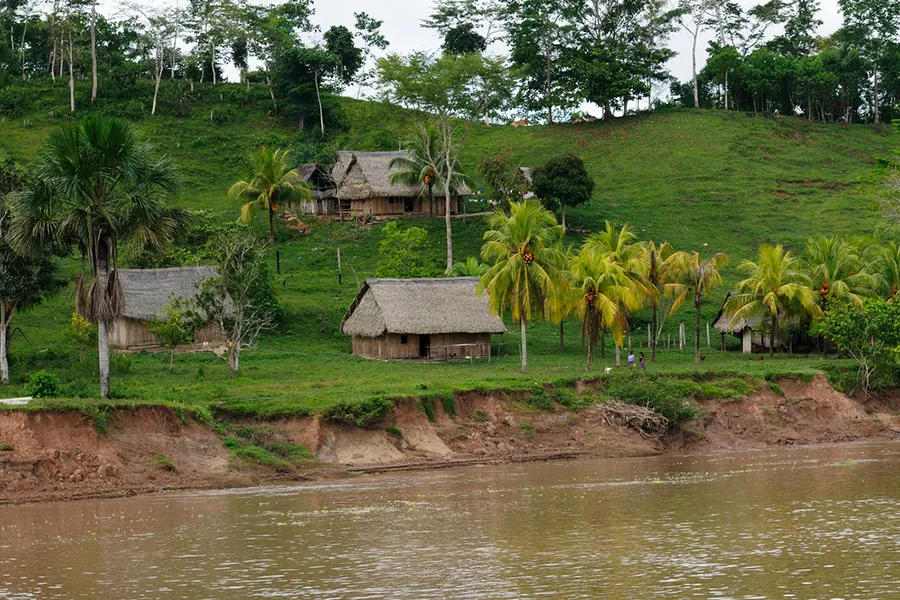
Pope Francis is visiting Peru from Jan. 18-21. During his first full day in the country, he met with indigenous people of the Amazon region in the city of Puerto Maldonado. The city lies in the Madre de Dios region in southeast Peru, and is considered the gateway to the southern Amazon jungle.

There are about 332,000 indigenous Peruvians living in the country’s Amazon region, of which 29,000 are within the Apostolic Vicariate of Puerto Maldonado.

The encounter included a performance of songs and dances by the ancient Arambut and an address by the Apostolic Vicar of Puerto Maldonado, Bishop David Martinez de Aguirre Guinea, O.P.

Before speaking, Francis also heard the testimonies of three Amazonian people. Copies of his 2015 encyclical, Laudato Si, translated into the local languages, were also distributed. Later in the day, he will have lunch with representatives of the Amazon.

In his speech, the Pope listed the different native groups which live in the Peruvian Amazon, thanking them for their attendance, and for giving him the opportunity to see, “closer up, in your faces, the reflection of this land.”

“It is a diverse face, one of infinite variety and enormous biological, cultural and spiritual richness,” he said.

The Pope also drew attention to the threats native Amazonians face on their own land, stating that at present they are probably some of the worst they’ve experienced.

He listed the different challenges they currently face, including “neo-extractivism,” which is when large businesses try to take possession of the petroleum, gas, lumber, and gold in the region.

There are also other movements that, “under the guise of preserving the forest, hoard great expanses of woodland and negotiate with them,” leading to situations of oppression for native people, who lose access to the land and its resources, he said.

Pointing to human trafficking, which he called a “devastating assault on life,” Francis strongly condemned, in particular, slave labor and sexual abuse, which are often linked with illegal mining, saying “the defense of the earth has no other purpose than the defense of life.”

He said that we cannot forget the words of St. Turibius, who at the Third Council of Lima in the 1500s said, “that not only in times past were great wrongs and acts of coercion done to these poor people, but in our own time many seek to do the same.”

“Sadly, five centuries later, these words remain timely,” he noted. “That prophecy must remain alive in our Church, which will never stop pleading for the outcast and those who suffer.”

Francis also focused on the good work of the Church in the Amazon, and the many missionaries throughout history who have devoted themselves to the region, defending its people and their cultures.

“Each culture and each worldview that receives the Gospel enriches the Church by showing a new aspect of Christ’s face,” he said. “Do not yield to those attempts to uproot the Catholic faith from your peoples.”

“The Church is not alien to your problems and your lives, she does not want to be aloof from your way of life and organization. We need the native peoples to shape the culture of the local churches in Amazonia,” he said.

He encouraged people to help their bishops and missionaries to be one with them, so that through inclusive dialogue they can help to shape the face of the Church.

It was in this spirit, Francis explained, that he decided to convoke an upcoming Synod of Bishops on the Amazon, which will take place in 2019.

The Pope also voiced his encouragement for those who use art, literature, craftsmanship and music to share their worldview and cultural richness with the world.

Much has been written and said about you by others, he said, but “it is good that you are now the ones to define yourselves and show us your identity. We need to listen to you.”

This is the reason I wanted to visit you and listen to you, he explained. “So that we can stand together, in the heart of the Church, and share your challenges and reaffirm with you a whole-hearted option for the defense of life, the defense of the earth and the defense of cultures.”

[…]