


Repetition, it’s said, can be the mother of learning. So, in light of recent Catholic debates about the pursuit of peace in the Middle East and elsewhere, permit me to reprise, with slight adjustments, parts of a column from twenty-four years ago.
The points I made then seem to me as salient today as when I first made them:
In his [2002] World Day of Peace message, John Paul II taught a truth many Catholics have seemingly forgotten: that “peace,” in the classic Catholic sense of the term, is a matter of order, the order that is built through law and politics.
After citing Vatican II’s teaching that peace is “the fruit of the right ordering of things with which the divine founder has invested human society,” John Paul reminded us that the “peace of order” has been the normative Catholic concept of peace for a very long time. As the pope put it, more than fifteen hundred years ago, St. Augustine argued that “the peace that can and must be built in this world is the peace of right order—tranquillitas ordinis, the tranquillity of order.”
From Augustine’s City of God down to the modern papal magisterium, the Second Vatican Council, and the Catechism of the Catholic Church, when the Catholic Church says “peace” it means “order”—the order that is built through politics and law on the foundations of justice (informed by charity) and freedom. …
“Peace” has many meanings. There is the “peace” that comes from a right relationship with God: the peace of inner serenity, which is a gift of grace. There is the “peace” of Isaiah’s vision of the “mountain … of the Lord,” where “they shall beat their swords into plowshares and their spears into pruning hooks; nation shall not lift up sword against nation, neither shall they learn war any more” (Isaiah 2:4): this is the peace of the Kingdom of God, a peace of God’s making, not ours.
And then there is the “peace” of order. It is a humbler sort of peace. It coexists with bruised souls and broken hearts. It is a peace in which swords remain, sheathed or used to defend order, but are not yet beaten into plowshares. This is real-world peace, the Catholic Church teaches, and it can be built within and among nations.
We know this by experience, for this is the peace we enjoy within democratic political communities. No one would suggest that all Americans live serenely within a right relationship with God, or that our country is a conflict-free zone. Yet the United States is at peace: the peace of a just political order, which is no small achievement for a society of 350 million human beings of dramatic religious, racial, ethnic, and philosophical diversity.
Why are we at peace? Because we have ways other than mass violence to resolve our conflicts: law and politics, legislatures and courts, the open debate of a civil society.
The same kind of “peace” obtains in those parts of the world that have decided to make diplomacy and law, not weapons, the instruments for resolving the inevitable conflicts that arise between nations. A war between France and Germany today is inconceivable.
Why? Because the French and Germans have become saints? Please. Because there are no conflicts between them? Hardly. No, there is real-world peace in one historic cockpit of European conflict because a thick network of international political, legal, and economic institutions has given the French and the Germans other ways to settle their differences. It’s the peace of order.
The peace of order is the peace that the just-war tradition of moral reasoning has sought to restore or build since Augustine first formulated just-war principles in the early fifth century. It is a serious mistake, therefore, to think that the just-war tradition and the pursuit of peace are somehow in opposition to each other.
The peace of order is the end; the just-war tradition asks: When and how can that peace of order be restored or built by means of the proportionate and discriminate use of armed force? It is the end of peace that justifies the means of military action.
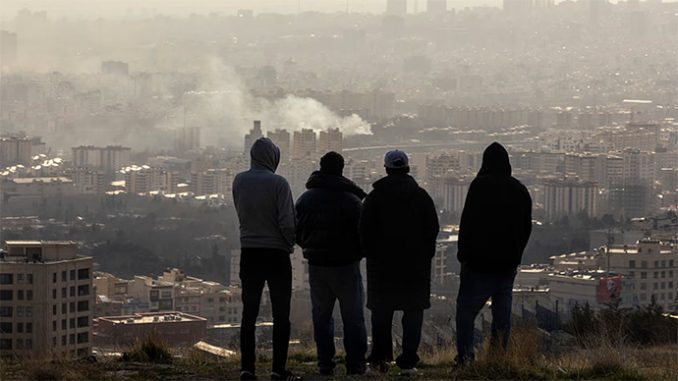
That is why defining the morally defensible goal being sought by use of armed force is a primary component of what the just-war way of thinking asks from statesmen. That definition is what has been missing from the Administration’s Iranian adventure, in which the goal seems to change with dizzying rapidity.
What would the peace of order look like in the Persian Gulf? That is the crucial just-war question that remains to be answered.
(Note: George Weigel’s column ‘The Catholic Difference’ is syndicated by the Denver Catholic, the official publication of the Archdiocese of Denver.)
If you value the news and views Catholic World Report provides, please consider donating to support our efforts. Your contribution will help us continue to make CWR available to all readers worldwide for free, without a subscription. Thank you for your generosity!
Click here for more information on donating to CWR. Click here to sign up for our newsletter.

Leave a Reply