


Sometimes—often—the news that is really significant isn’t recognized as such. Something of very considerable importance has been happening in Kazakhstan. Yes, that’s right. Kazakhstan. Most people in Europe or the Americas would be hard-pressed to place it on a map. But it’s an area of grim and massive historical significance: here were some of the most terrible concentration camps of the Gulag Archipelago, that ghastly prison network described in such unforgettable detail by the writer Alexander Solzenhitsyn, who suffered there, in the days of the USSR.
The Union of Soviet Socialist Republics—how dated and weird the name sounds! Based on the doctrine of Marxist-Leninism, it survived for some six decades through a vicious system of police spies, arbitrary arrests, prisons, torture, and the crushing of religious or political opposition. It fell at the start of the 1990s in that dramatic series of events which began with the election of a Polish pope in 1978—of whom more in a moment.
Today, Kazakhstan is a struggling nation state, freed from the Soviet grip and writing new chapters of its history. It has a tiny Catholic population—perhaps 1 percent of its people—a substantial Muslim majority, and a good number of Orthodox Christians.
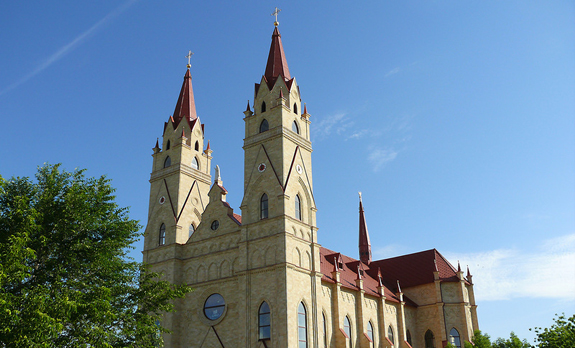
And a great cathedral dedicated to Our Lady of Fatima has just been built and opened there, in Karaganda, the capital of the Karagandy Province in Kazakhstan
Fatima: a small village in Portugal that is famous for the apparitions of Our Lady which took place there in 1917, the year of the Russian Revolution that brought Communism and the Gulag. Fatima: the name of the favorite daughter of Mohammed and a central figure in Islam. The village in Portugal has a direct connection with the Islam’s Fatima. Portugal was for a long time occupied by Islamic armies (the Moors) and a local princess—named Fatima after Mohammed’s daughter—lived at Ouyrem Castle, near the village. She converted and became a Christian, but the village retained her original name.
Most Catholics are familiar with the essence of the story of the Fatima apparitions. Three country children—uneducated, not attending school, busy most days looking after the family’s livestock in this small rural community—saw a vision of a beautiful woman, in a tree, when they were out in the fields. It was May 13, 1917. She told them many things, among which was a strange message about Russia: “Russia will be converted.” They did not know what she was talking about: never having studied geography or been taught about the various different nations of the world, they assumed that “Russia” was a woman, perhaps a wicked one for whose soul they should pray. The message that “Russia will be converted” seemed puzzling to them but, as instructed, they reported it faithfully. The Virgin Mary had told them that, unless people prayed and did penance, the war then raging—this was all during World War I, which the children did of course know about—would be followed by another and worse war. The Holy Father must “consecrate Russia to me,” Mary said.
The rest of the Fatima story has become very well known: a great shrine was built at the site of the visions, and pilgrims go there in great numbers. Two of the children, Jacinta and Francisco, died in the terrible influenza epidemic that swept Europe in the wake of the First World War, the third, Lucia, became a nun and lived in seclusion in a contemplative convent until her death in 2005. After World War II, with the spread of Russia’s empire across Eastern Europe, the “message of Fatima” was central to Catholic life. These were the days of the Cold War: Mary had said that Russia would “spread her errors across the world, causing wars…” and this indeed was happening as the Communist doctrine insisted on world domination. Countries that tried to break free from Russia’s grip were invaded: Hungary in 1956, Czechoslovakia in 1968.
People prayed, and went to Fatima on pilgrimage—they also speculated a lot. There was discussion about what came to be called the “Third Secret” of Fatima—a message which Sister Lucia had written down and which was to be read by the Pope, in 1960 or some date after that he felt was suitable. The Pope did not reveal the message in 1960 and speculation continued, although as world events crowded the 1970s (Vietnam, hippies, the sexual revolution) somehow Fatima, along with the Cold War generally, seemed a tired saga that had already run a long time.
Fast-forward to May 13, 1981. The Polish pope, John Paul II, whose election had ended the centuries-long Italian domination of the papacy, given the world its first Slav pope, and shattered the geo-political status quo of Europe, was shot in St. Peter’s Square. The assassin was a trained hit man, and his aim was sure. The Pope should have died. The bullet went straight into his stomach. He fell, and his aides rushed to hold him: as they sped him to hospital—the whole square now in an uproar, the assassin hurled to the ground by the crowds and arrested by police—they heard him praying “Mary, my mother…”
He did not die. As he later put it: “One hand fired the bullet, another guided it.” By a fraction of a centimeter, the bullet had missed his vital organs. Thanks to his strong constitution, and despite being attacked by a virus—some of the blood he was given in transfusion turned out to have been infected—he was able to broadcast to the world from his hospital bed and to return to work within weeks. During his time of convalescence, he pondered the significance of what had happened. The date of the assassination attempt was May 13, the Fatima feast-day. He sent for the letter written by Sister Lucia, the famous “secret.” He read it. The following year, on May 13, he led a great pilgrimage to Fatima and presented to the shrine the bullet which had so nearly killed him. Astonishingly, it fitted perfectly into the round gap at the base of the crown on Mary’s statue: it is there to this day.
In 1984 Pope John Paul consecrated the world to Mary, informing the world’s bishops that they must unite with him in this act. In 1989 Communism in Eastern Europe crumbled, in 1990 the Berlin Wall came down, and soon the USSR was no more.
In the year 2000—perhaps to prevent millennial speculation over the “Third Secret,” about which there had been so much talk over the years—Pope John Paul ordered its publication. Sister Lucia had written it down in the form of a letter, on an old-fashioned sheet of notepaper folded into four. It described an extraordinary vision—which, as a child growing up without ever having seen a TV or movie, she described as being like seeing something in a mirror when you walk in front of it. A ruined city, people suffering, many corpses, a figure in white, whom the children took to be the Holy Father, shot and killed amid the crowd.
This image—so obviously linked to the 20th century’s martyrs, more than in all previous centuries combined, and to the shooting of the Pope—brought headlines. It all fitted with the request for prayer and penance, with the description of Russia spreading her errors, with the destruction of nations. It was a sort of summary of the miseries endured by so many in the 20th century.

And so to Kazakhstan. Bishop Athanasius Shneider, auxiliary in that country, has become well-known for his criticisms of modern liturgical practices, notably Communion in the hand, the absence of kneeling for Communion, and Mass where the priest faces the people rather than ad orientem. But perhaps more significant has been his energetic commitment to the cathedral of Our Lady of Fatima.
Kazakhstan is mission territory: ex-Soviet, heavily Muslim, with a big Orthodox presence, it combines the need for massive evangelization with ecumenical and inter-faith challenges. Under Soviet rule, three generations were taught an official atheist creed. There has been massive scope for religious illiteracy, for superstition, for confusion, for bigotry.
This cathedral has been built for the Church of tomorrow. It will be a Church that is strong in the East and weak in the West. It will not be the Church that we have known: of polite ecumenical dialogue and Western affluence and decadence and falling church attendance. It will have nasty aspects: there is a rich heritage of martyrdom but also tangled national, racial, and political issues which festered during the 20th century, when the Soviet system blocked open discussion and healthy debate. Anti-Semitism is not unknown among the peoples of the former USSR, and millions there will not have listened to Popes John Paul and Benedict denouncing this evil. It will have to battle with these and other issues, and in a new era with the Church having to adapt from its centuries-old sense of having a secure base in Western Europe.
And we are going to have to take a fresh look at Fatima. As Pope Benedict said when leading a pilgrimage to the shrine two years ago, the message certainly isn’t something that just belongs to the past. He meant that prayer and penance are still necessary, and that Mary’s intercession is still central to the mission of the Church in our day. Fatima is linked to Islam. It is linked to the future of the lands where Russia “spread her errors.” It is hugely significant that the new cathedral, a statement of faith in the future, has been dedicated to Our Lady of Fatima in the land of the Gulag.
And this is important: Pope—now Blessed—John Paul did not lie when he announced the publication of the Third Secret. A whole minor industry has grown up around the fevered speculation that “the Secret hasn’t really been revealed,” with dark tales of Masonic plots, and whispered conversations, and envelopes held up to the light. There are websites and newsletters, angry rambling booklets and passionate denunciations. One group insists that Sister Lucia died (or was locked away for years and unable to communicate) and that the nun photographed with Pope John Paul and with Cardinal Bertone and others was a lookalike. All of this is nonsense.
What matters is that Mary spoke, the Church responded, history—which has a shape and a destiny, as Christ will one day return in glory—unrolls, and each one of us has a tiny part to play in it. Mary’s call was for prayer and penance: the essence of the Christian life. As Pope Benedict emphasized when he visited Fatima, the message isn’t something to be consigned to the past.
So: what next? Think about Fatima as the Church meets Islam—for centuries, the two faiths have clashed, and now they meet in Europe, in what was once the heartland of Christianity. If the Church in Western Europe is to survive, it needs prayer and penance on a massive scale. And think about Russia and the lands that Russia dominated for so long: we need prayers for unity between Catholic and Orthodox, for a new and deep spreading of the Faith to generations hungry for truth.
Already, the Christian revival in Russia has been astonishing: churches are full, a relic said to be part of Mary’s girdle drew millions—literally—to venerate it, and icons and religious images are ubiquitous. There is ignorance, confusion, and muddle about basic doctrines, a lack of good religious education, and sometimes strong and unhealthy associations between religious faith and racial and national identities. There is scope for things to go wrong. But the undeniable reality is that Christianity, for decades assumed to be something that would fade from Russian soil, is going to be the great and dominant fact of Russian life in the 21st century.
Did you pray for the conversion of Russia in the days of the Cold War? Did you sense, with Blessed John Paul, something extraordinary about the events of May 13, 1981? Did you watch, on TV, the Berlin Wall coming down? Do you think that most people in the USA or Europe were noticing the events of an obscure rural corner of Portugal in 1917? Do you think that most people understand the significance of a new cathedral in an obscure corner of what was once prison territory in a corner of a vanished empire?
“Mary, my mother…” said Blessed John Paul. At the place where he fell in St. Peter’s Square there is now a small marble stone bearing his papal insignia, and if you look directly up you will see, on the wall of the Apostolic Palace, the mosaic of Mary, that he asked to have placed there with its dedication “Totus Tuus.” She answered his plea for help, and he lived. And we should send our prayers to her, and she will answer those too.
If you value the news and views Catholic World Report provides, please consider donating to support our efforts. Your contribution will help us continue to make CWR available to all readers worldwide for free, without a subscription. Thank you for your generosity!
Click here for more information on donating to CWR. Click here to sign up for our newsletter.
